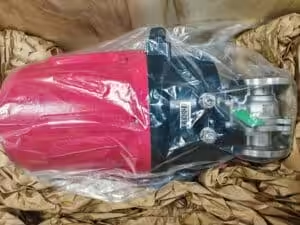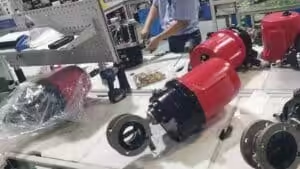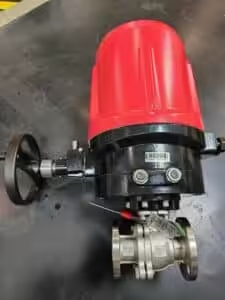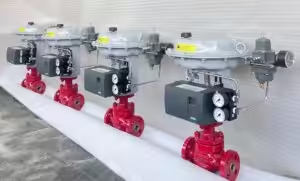
A spring-return electric actuator can move a tunnel damper to a defined position when its power supply is lost. Whether that position should be open or closed depends on the damper’s role in the tunnel ventilation strategy. The actuator must follow the fire and smoke-control design for its specific zone.
For tunnel contractors and ventilation-equipment manufacturers, the critical task is to match the damper, actuator and controls as one assembly. THINKTANK’s spring-return electric actuator range provides a starting point for this review, with mechanical interfaces and operating options published on our technical product page.
Does a tunnel smoke-control damper always fail open?
No. A damper serving an active extraction zone may need to open, while another damper may need to remain closed to preserve the intended airflow path. Other installations use different ventilation arrangements. The loss-of-power position must be recorded tag by tag, alongside the commanded fire-mode position.
PIARC’s Road Tunnels Manual explains how ventilation arrangements manage smoke using different airflow and extraction strategies. The procurement implication is practical: “spring return” describes an actuator mechanism, while the approved ventilation strategy determines where each damper needs to move.
| Condition | Question for the control designer |
|---|---|
| Normal ventilation | Which damper position or operating range supports routine air-quality control? |
| Fire detected in a defined zone | Which dampers open, which close, and how are the fans sequenced? |
| Actuator supply lost | What is the required mechanical return position for this tag? |
| Communication lost, power available | Does the local controller hold, move or await a hardwired instruction? |
| Power restored | Is an automatic restart allowed, or is a controlled reset required? |
Is a pipeline butterfly valve the same as a smoke-control damper?
Both may use a quarter-turn actuator, but their mechanical duty and acceptance requirements differ. A pipeline butterfly valve contains a liquid or gas under pressure. A ventilation damper controls airflow through a duct or opening. Blade geometry, seals, bearings, linkage, temperature exposure and leakage criteria can all differ.
Select the device for its actual service. If the project requires a fire or smoke-control classification, obtain evidence for the specified damper assembly and installation arrangement. Fitting a spring-return actuator to a general-purpose butterfly valve does not by itself establish a tested smoke-control assembly.
How should actuator torque be checked?
Start with the damper manufacturer’s torque requirement at the design airflow or pressure differential, including seal friction, bearings and linkage losses. Review the maximum demand through the complete stroke. Then compare it with both the powered actuator output and the available spring-return output.
The final seating or opening movement matters just as much as the initial movement. A headline torque rating does not show every point on the torque curve. The selection should document the sizing allowance, temperature assumptions, mounting orientation and any effect of a linkage ratio. Avoid using the duct diameter alone as the actuator-sizing basis.
Keep fire temperature, ambient temperature and enclosure protection separate
| Specification | What it needs to describe |
|---|---|
| Normal ambient rating | The temperature and humidity around the actuator during routine operation. |
| Fire-duty requirement | The required temperature, duration, operating movement and position retention for the assembly. |
| Ingress protection | The specified resistance to dust and water at the installed enclosure and cable entries. |
| Heat protection | The tested arrangement, clearance, cable routing and access requirements of any protective enclosure. |
| Electrical reliability | Power, control and feedback provisions required by the project’s fire strategy. |
An IP rating does not establish a fire-temperature rating. A protective cover also needs an installation and test basis that matches the proposed equipment. THINKTANK’s technical page lists a customizable heat-shield option; confirm its scope and the project’s acceptance requirements before incorporating it in a damper package.
What should a tunnel actuator FAT include?
- Assembly and travel: verify the shaft interface, coupling engagement, mounting rigidity, stops and the actual blade position.
- Power-loss response: demonstrate spring return from the specified operating positions and record the time and final position.
- Signals: check open/closed contacts, position disagreement alarms and the defined behavior when control communications are lost.
- Mechanical loading: agree how the test represents the damper load and identify any checks that require the complete duct or damper assembly.
- Manual operation: demonstrate the override procedure, any locking arrangement and restoration of automatic fail action.
- Records: identify the tested tag, actuator model, wiring revision, return direction and measured results.
Factory testing confirms the agreed equipment behavior. Integrated site testing then verifies the ventilation sequence with fans, dampers, sensors and the control system. A command shown on a SCADA screen should be checked against the damper’s physical position and the system response.
How can THINKTANK help a damper manufacturer or contractor?
THINKTANK publishes actuator dimensions, mounting-flange information and valve assembly examples so OEMs can review fit and access early. Our engineering development workflow describes the use of 3D models, design review and test-bench verification for customized valve work.
For a tunnel inquiry, provide the damper drawing, shaft and flange details, operating torque curve, airflow or differential-pressure conditions, required return direction, powered and return times, available voltage, temperature duty and control schematic. Include the project’s required assembly tests and acceptance documents in the same inquiry.
Discuss the actuator before the damper design is frozen
Send THINKTANK your tunnel damper drawing and cause-and-effect requirements for an actuator matching review. Early agreement on torque, interfaces and fail position helps the mechanical and electrical teams work from the same specification.
For different operating conditions, see our application notes on data-center fuel and cooling valves and marine spring-return valve selection.