— From the Perspective of THINKTANK Control Valve Engineers
Why we always separate “fail position” from “interlock action”
When customers report that a control valve moved in the wrong direction during an interlock, the first thing we clarify is this:
Solenoid valve action and control valve fail position are two different engineering concepts.
In many chemical plants, these two are mistakenly treated as the same thing.
- Fail position is the valve’s response to loss of signal, power, or air
- Solenoid valve action is the result of a process interlock command
Confusing these two is one of the most common root causes of control valve accidents during commissioning and early operation.
How solenoid valves really function in interlock systems
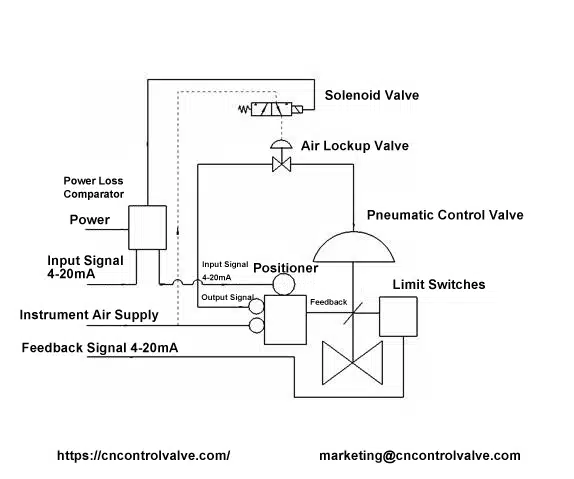
From an engineering perspective, a solenoid valve is not a “safety device” by itself.
It is simply:
- a pneumatic switching element,
- executing a logic decision defined by the cause-and-effect diagram.
Whether the control valve opens, closes, or locks during an interlock depends entirely on:
- solenoid valve type (3/2, 5/2, normally open or normally closed),
- air routing design,
- and actuator configuration.
If any of these are misunderstood or incorrectly implemented, the valve may respond exactly opposite to what the process requires.
A typical accident we help customers investigate
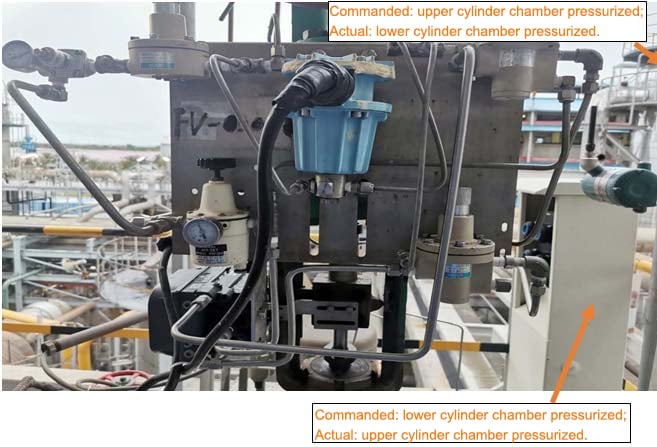
One common case we have seen occurs after maintenance or modification.
What changed:
- Valve accessories were replaced with a different model
- Installation orientation changed
- Pneumatic tubing had to be re-routed
What went wrong:
- The technician reconnecting the tubing did not fully understand the interlock logic
- The actuator air lines were connected incorrectly
- During interlock testing, the valve moved in the wrong direction
- The unit tripped immediately
From the plant’s perspective, this looked like a “valve failure.”
From our perspective, it was a pneumatic logic execution error.
Why this type of error is so dangerous
What makes solenoid valve logic errors particularly risky is that:
- Normal control may appear completely correct
- Manual operation may also appear normal
- The error only appears when the interlock is activated
This means the problem often remains hidden until:
- the first real process upset,
- or the first emergency shutdown.
At that moment, there is no time to diagnose — only consequences.
Why drawings alone are not enough
Many plants have:
- P&IDs,
- pneumatic schematics,
- cause-and-effect diagrams.
Yet we still see these accidents.
The reason is simple:
Having a correct diagram does not guarantee correct execution on site.
During troubleshooting, we often find:
- air lines connected based on physical convenience,
- solenoid ports misunderstood,
- or assumptions made without confirming actuator behavior.
Without physical testing, even a perfectly correct drawing provides false confidence.
How THINKTANK engineers approach solenoid valve troubleshooting
When we support customers facing this issue, we follow a structured approach.
First, we confirm the required interlock result
- not from memory,
- but directly from the cause-and-effect diagram.
Second, we verify the pneumatic logic physically
- tracing each air line,
- confirming solenoid valve port functions,
- checking actuator response step by step.
Third, we test the interlock deliberately
- observing real valve motion,
- confirming that the final position matches the process safety requirement.
Only after these steps do we consider the system acceptable for operation.
Engineering corrections we typically recommend
Based on repeated field experience, we recommend the following practices.
Before testing or commissioning:
- Clearly define both the valve fail position and the solenoid valve interlock action
- Do not assume they are the same
During installation and modification:
- Execute pneumatic routing strictly according to approved schematics
- Do not allow undocumented changes during re-piping
Before putting the valve into service:
- Perform full interlock testing under real conditions
- Verify valve motion, not just solenoid energization status
These steps are simple, but they prevent some of the most disruptive control valve incidents we see.
Our engineering conclusion
From the THINKTANK perspective, solenoid valves do not cause accidents by failing.
They cause accidents by working exactly as connected, while the system logic behind them is misunderstood.
A control valve that moves the wrong way during an interlock is not unpredictable —
it is executing a logic error that was never verified.