Why valve performance increasingly depends on system integration
In modern process plants, control valves rarely operate alone.
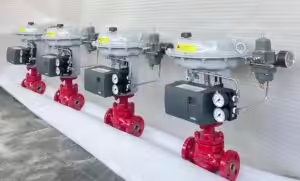
They are embedded in automation systems, connected to controllers, sensors, diagnostics, and safety logic.
As automation capabilities increase, a new misconception often appears:
If the control system is advanced enough, the valve will take care of itself.
In reality, advanced automation raises the bar for valve engineering—it does not lower it.
Why Automation Changes the Role of the Control Valve
Traditional control valves were designed primarily as mechanical flow regulators.
In automated plants, valves increasingly act as system participants:
- Receiving frequent position commands
- Responding to dynamic process signals
- Interacting with diagnostic and safety layers
- Operating continuously across wide load ranges
In this environment, valve performance is no longer defined by mechanics alone, but by how well it integrates with control logic.
Common Automation-Related Failure Patterns
As automation sophistication increases, new failure modes become more visible.
Control Instability Misdiagnosed as Tuning Issues
Oscillation or hunting is often blamed on PID tuning. In many cases, the root cause lies in valve response behavior—deadband, friction, or non-linear trim characteristics.
Diagnostic Data Without Engineering Context
Modern positioners generate large amounts of data. Without correct interpretation, diagnostics can lead to unnecessary maintenance or missed early warnings.
Automation Exposing Mechanical Weaknesses
Frequent small movements demanded by advanced control strategies accelerate wear in valves not designed for high-cycle operation.
Automation does not create these problems—it reveals them.
What “Advanced Automation Features” Really Mean
From an engineering perspective, automation capability is not about the number of features, but about predictable interaction between valve and system.
Key elements include:
- Consistent, repeatable valve response
- Minimal hysteresis and deadband
- Stable behavior under varying signal quality
- Compatibility with control and safety architectures
A valve that behaves unpredictably undermines even the most advanced control strategy.
Typical Field Situation: Automation Upgrade, New Problems
In a plant modernization project, advanced control algorithms were introduced to improve efficiency. Existing control valves met mechanical specifications but were not designed for frequent, small-position adjustments.
After automation upgrade, control loops became unstable and maintenance frequency increased. The issue was not controller logic, but valve behavior under high-cycle operation.
By addressing valve friction, response characteristics, and actuator matching, the automation system achieved its intended performance.
Engineering takeaway:
Automation performance depends as much on valve behavior as on control logic.
Why Automation and Safety Cannot Be Separated
Advanced automation often operates alongside safety systems:
- Emergency shutdown logic
- Interlocks
- Override controls
In these cases, control valves must transition reliably between normal control mode and safety action.
Any ambiguity in valve behavior during this transition introduces system-level risk—regardless of how sophisticated the automation platform may be.
Engineering Perspective from THINKTANK
From an engineering standpoint, THINKTANK treats automation compatibility as a system design requirement, not an accessory feature:
- Valve mechanics are evaluated for high-cycle and low-amplitude operation
- Response characteristics are aligned with control strategy requirements
- Integration with automation and safety layers is considered early in design
- Diagnostics are used to support engineering decisions, not replace them
This approach ensures that automation enhances valve performance rather than exposing hidden limitations.
How Engineers Should Evaluate Automation-Ready Valves
A practical system-level evaluation asks:
- How does the valve behave under frequent small movements?
- Does diagnostic data reflect real mechanical condition?
- Can the valve transition cleanly between control and safety modes?
- Does automation reduce or amplify wear over time?
Automation readiness is therefore about behavior under real operating conditions, not feature lists.
System-Level Engineering Insight
Advanced automation does not compensate for weak valve design.
It amplifies both strengths and weaknesses.
In automated systems,
control valves must be designed as system elements—
not just mechanical devices.
Understanding this interaction is essential for achieving stable, reliable automation performance.