— From the Perspective of THINKTANK Control Valve Engineers
Why mechanical stops are safety devices, not optional accessories
In many plants, mechanical stops on control valves are treated as secondary hardware.
From our engineering perspective at THINKTANK, this is a serious misunderstanding.
A mechanical stop serves two critical purposes:
- it protects the process and equipment by limiting valve travel,
- and it prevents severe sticking or jamming under specific operating conditions.
A mechanical stop is not installed to restrict control.
It is installed to guarantee that control remains possible when conditions change.
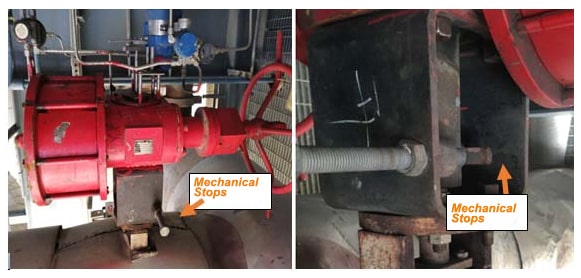
Why mechanical stops are often removed during maintenance
Mechanical stops are commonly removed during valve overhaul or calibration for a practical reason:
- full-stroke calibration requires the stop block to be removed,
- otherwise, the valve cannot be verified over its entire travel range.
This step is technically correct.
However, a key risk appears after calibration is completed.
If the mechanical stop is not reinstalled due to oversight, the valve is left without a critical protection mechanism.
This is not a design flaw — it is a maintenance control failure.
A typical incident following turnaround maintenance
One representative case occurred after a major plant turnaround.
What operators experienced:
- the valve could not be opened by remote control,
- manual operation using the handwheel also failed,
- the system was forced to shut down,
- startup was delayed significantly.
What initial checks showed:
- actuator and accessories were functioning,
- control signals were correct,
- no obvious mechanical damage was visible.
From a control system perspective, everything looked normal — yet the valve remained stuck.
Root cause: mechanical stop not reinstalled
The root cause was identified only after reviewing valve documentation.
The valve design required a mechanical stop.
However:
- the stop block had been removed during calibration,
- and was never reinstalled after loop check and commissioning.
When the valve temperature reached a certain range during startup, severe sticking occurred.
Without the mechanical stop, the valve jammed and could not be moved — neither remotely nor manually.
The valve did exactly what physics dictated.
The system failed because a simple protective measure was missing.
Why this problem is so disruptive during startup
Mechanical stop issues are particularly damaging because:
- they often appear only during startup or load change,
- they affect both automatic and manual operation,
- and they usually require valve disassembly to resolve.
At this stage, troubleshooting is no longer a control issue — it becomes a mechanical intervention that directly delays commissioning.
How THINKTANK engineers verify mechanical stop integrity
When we review valves after maintenance, mechanical stops are treated as checklist items, not assumptions.
Our verification includes:
- confirming whether mechanical stops are required for each valve,
- physically checking that stop blocks are installed,
- verifying stop position against design documentation,
- and ensuring stop presence is recorded before startup.
This verification is simple, but it prevents days of lost time.
Engineering corrections we typically recommend
Based on repeated field experience, we recommend three corrective actions.
- Establish a complete mechanical stop inventory for the entire plant
Every valve with required mechanical stops should be clearly listed. - Mark mechanical stop requirements clearly on site
Visual identification reduces reliance on individual memory or experience. - Strictly enforce valve maintenance quality control checklists
Mechanical stop reinstallation must be a mandatory sign-off item, not an assumed step.
These measures convert a fragile process into a repeatable one.
Our engineering conclusion
Mechanical stops rarely fail on their own.
Problems arise when they are silently removed from the system.
From our perspective:
A control valve that cannot be opened when it matters most
is often revealing a maintenance detail that was overlooked, not a design problem.
Small components do not cause small consequences.
They cause delays, rework, and lost confidence — all of which are far more expensive than the part itself.