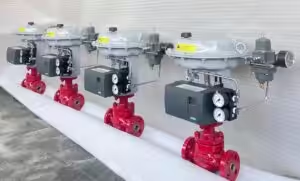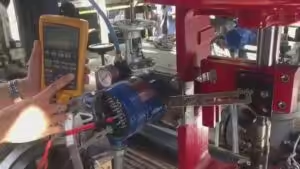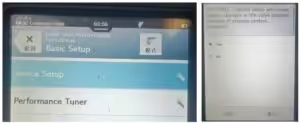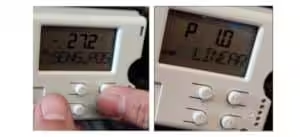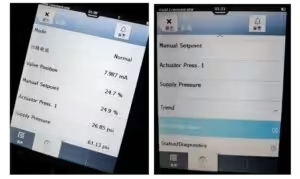
— From the Perspective of THINKTANK Control Valve Engineers
Why loop check problems are rarely noticed — until a trip happens
In most projects, control valve loop checking is treated as a routine task.
The controller output is changed.
The valve moves.
The position feedback looks reasonable.
The loop is marked as “checked.”
From our experience at THINKTANK, this is exactly where a hidden risk often remains.
A control valve may respond to the controller, yet the action direction between the DCS output and the actual valve position is wrong.
Under manual operation, this may not be obvious.
Under automatic control, it can become a direct cause of interlock trips.

What loop check really means in engineering terms
A proper loop check is not just confirming that:
- the valve moves,
- or the signal is transmitted.
It is a verification that:
DCS controller output direction and on-site valve position indication are fully consistent.
In other words:
- increasing controller output must always produce the intended valve movement,
- and the physical valve position must match the process control logic.
Any inconsistency here is a system-level risk, not a minor adjustment issue.
Why reversed action valves are especially dangerous
In some units, a small number of control valves are intentionally configured with reversed action between:
- controller output,
- and valve position.
These cases usually exist for historical or process-specific reasons.
The problem is not the configuration itself.
The problem is that only a few experienced individuals are aware of it.
When maintenance work involves:
- replacing valve accessories,
- re-routing pneumatic tubing,
- or changing positioners,
and this special requirement is not clearly recognized, the original logic can be unintentionally broken.
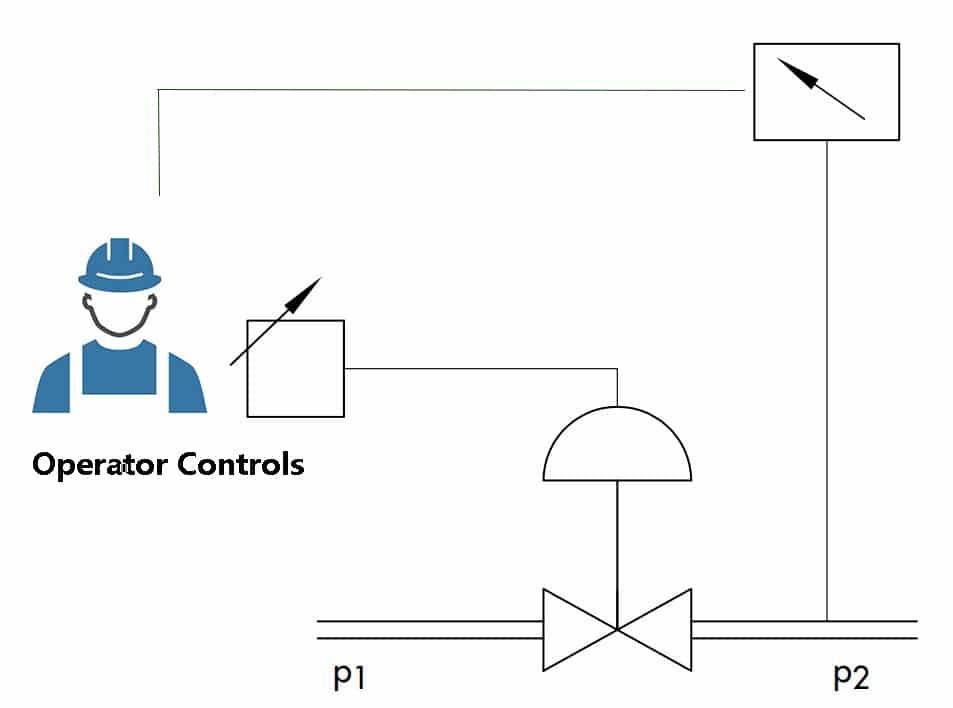
A typical failure scenario we help customers investigate
This type of incident usually follows a familiar pattern.
What changes on site:
- Valve accessories are replaced
- Pneumatic tubing is reconnected
- Loop check is performed based on “normal assumptions”
What is missed:
- The valve is one of the few with reversed action logic
- DCS output and valve position indication are no longer consistent
What happens during operation:
- The valve responds opposite to the controller’s intent
- Automatic control becomes unstable
- The control loop behaves abnormally
- An interlock is triggered, causing a unit trip
From the plant’s perspective, this looks like a sudden control failure.
From an engineering perspective, it is a loop check consistency failure.
Why this problem often survives commissioning
This issue is difficult to catch because:
- manual mode operation may still appear reasonable,
- the valve may move through its full stroke,
- position feedback may still change smoothly.
However, when the loop is placed in automatic mode, the incorrect action direction immediately becomes critical.
Without deliberate verification of action consistency, the problem can pass through commissioning unnoticed.

How THINKTANK engineers verify loop check correctness
When we review loop check results, we focus on one fundamental question:
Does the DCS output direction truly match the physical valve action and position indication?
Our verification includes:
- observing valve movement while increasing and decreasing controller output,
- confirming valve opening/closing direction against process intent,
- checking consistency between local position indication and DCS display.
This is done deliberately, not as a checkbox exercise.
Engineering corrections we typically recommend
Based on field experience, we recommend the following practices.
- Loop check acceptance must include action direction verification, not just signal transmission
- Any valve with non-standard or reversed action logic must be clearly documented and highlighted
- After accessory replacement or re-piping, loop check consistency must be re-verified
- DCS output direction and valve position indication should be unified as early as possible during project commissioning
These measures eliminate a class of failures that are otherwise difficult to diagnose after startup.
Our engineering conclusion
From our perspective, loop check errors are not control tuning problems.
They are system integration problems.
A control valve that responds opposite to the controller’s intent is not misbehaving —
it is revealing that the control system was never fully aligned.
Loop check is not about confirming that the valve moves.
It is about confirming that the system thinks and acts in the same direction.
Related commissioning references cover installation and commissioning failure sources, positioner error and deadband, fail-position verification, and solenoid-valve interlock logic. These checks should be reconciled with the site cause-and-effect documentation before the loop is accepted.