Please enter the relevant terms or keywords you need to consult, and relevant articles will appear in the search results. If you can’t find the answer you need, please feel free to contact us and we will be happy to help. Or you can directly send an email to [email protected]
— From the Perspective of THINKTANK Control Valve Engineers
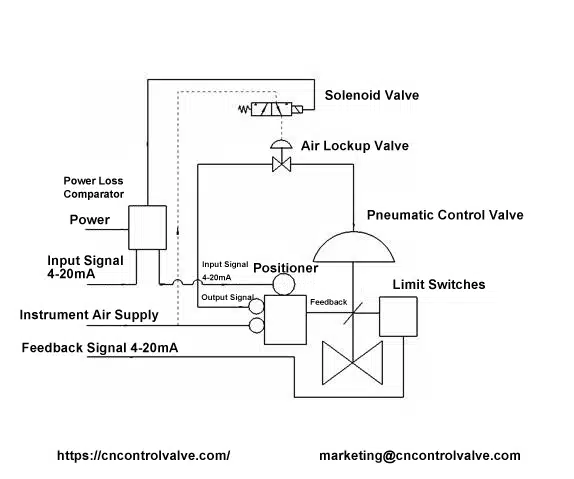
Why we treat air lock valve trip setting as a critical control parameter
In chemical plants, air lock valves are often regarded as secondary pneumatic accessories. In reality, from our engineering experience at THINKTANK, the air lock valve trip setting is a critical control parameter that directly determines whether a control valve remains controllable during normal operation.
Many control valve “loss of control” incidents are not caused by DCS failure, positioner malfunction, or actuator problems, but by unverified or drifting air lock valve trip settings.
control valve failure modes
Why this problem usually appears after valve maintenance
This type of failure most commonly occurs after valve maintenance or overhaul, not during initial commissioning.
The reason is practical and well known on site:
Air lock valve trip setting testing requires temporary pressure test equipment
The test procedure is relatively cumbersome
As a result, many sites only perform a basic check:
instrument air is fully isolated,
and the valve is confirmed to move to its fail position
However, this check does not answer the key engineering question:
At what pressure does the air lock valve actually trip?
In most installations, there is no permanent pressure gauge installed upstream of the air lock valve. Without adding an external pressure gauge during commissioning or recommissioning, the real trip setting simply remains unknown.
Accident mechanism — aligned strictly with field cases
Based on field investigations, the accident mechanism follows a clear and repeatable chain.
The air lock valve has been in service for a long time without trip-setting verification
internal spring and diaphragm components age over time
trip setting may drift from its original value
in some cases, the setting may also have been manually altered
Instrument air piping leakage exists upstream of the air lock valve
leakage causes a gradual reduction of pressure at the air lock valve inlet
this pressure reduction may go unnoticed during normal operation
The reduced inlet pressure reaches the (drifted) air lock valve trip setting
the air lock valve actuates
the actuator is isolated from the control air signal
The control valve loses controllability
the valve no longer follows the controller output
automatic control becomes ineffective
process instability or unit trip may occur
The key point is that the air lock valve does not malfunction. It trips exactly as designed — based on a trip setting that was never verified.
Why this failure mode is difficult to detect in advance
This type of failure is difficult to detect because:
DCS output remains normal
Positioner feedback remains normal
No interlock or alarm is generated
The valve appears mechanically intact
Only when the valve fails to respond to controller output does the problem become visible — often too late.
If the air lock valve trip setting is unknown, operators and engineers have no reference to judge whether its actuation pressure is reasonable or not.
How THINKTANK engineers verify air lock valve trip settings
When supporting customers, we do not rely on assumptions.
Our verification method is straightforward and repeatable:
an external pressure gauge is temporarily installed upstream of the air lock valve
supply pressure is adjusted gradually under controlled conditions
the exact air lock valve trip pressure is observed and recorded
the measured value is compared with the original design requirement
This method directly answers the only question that matters: when does the air lock valve actually trip?
Engineering corrections we recommend
Based on field experience and consistent with industry practice, we recommend the following corrective actions:
After valve maintenance, the air lock valve trip setting must be tested according to the proper procedure Verifying only full air-loss fail action is insufficient.
Air lock valves that have been in long-term service should be replaced when trip-setting stability cannot be ensured Most air lock valves use spring–diaphragm structures, and diaphragms are rubber components subject to aging.
These actions directly eliminate one of the most overlooked sources of control valve instability.
Engineering conclusion
From our perspective, air lock valves are not passive accessories.
If their trip settings are unknown, unverified, or drifting, they become hidden control logic elements capable of disabling a control valve during normal operation.
A control valve that suddenly stops following its controller is often revealing a problem that has existed quietly for a long time.
After earning my bachelor's degree in mechanical engineering from Zhejiang Normal University in 2008, l was fortunate enough to begin my career with Siemens, Fisher, and YTC, focusing on control valve accessories. Over the past dozen years, l've poured my heart and energy into understanding technology and fluid solutions for control valves.
Now, as the marketing director for THINKTANK, a trusted branch of the Taiwan STONE valve group, I can't help but feel proud of how far we've come. Our knowledge isn't just reaching professionals like engineer and valve distributors; it's also inspiring the next generation of automation college students.
l genuinely hope you're enjoying our articles and finding them helpful. Your thoughts, questions, and feedback mean the world to me, so please don't hesitate to reach out to [email protected]. Whether you're a seasoned expert or just curious about the field, I'm here to connect, share, and learn together.
I am the author of this article, and also the CEO and marketing director of THINKTANK, with 15 years of experience in the industrial valve industry. If you have any questions, you can contact me at any time.
Just fill out your name, email address, and a brief description of your inquiry in this form. We will contact you within 24 hours.
Why are more and more international valve brands choosing THINKTANK for OEM service?
Brand is reputation, which not only requires high valve technology, but also great comercial support and fast response after-sales service and delivery time. They will not gamble their brand on an unknown product
Avoid your inquiry is delay response, please enter your WhatsApp/Wechat/Skype along with the message, so we can contact you at the very first time.
We will reply you within 24 hours. If for urgent case, please add WhatsApp: +86 185 1656 9221, or WeChat: +86 199 2125 0077. or call +86 189 5813 8289 directly.
Get An Instant Quote
Get An Instant Quote
We will reply you within 24 hours. If for urgent case, please add WhatsApp: +86 199 2125 0077, or WeChat: +86 199 2125 0077. Or call +86 189 5813 8289 directly.
Direct to Control Valve Factory With Competitive Price & Reliable Quality
Get An Instant Quote
Just leave your name, email, and simple message or requirements, We will contact you within 1 hour.