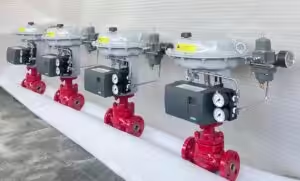
For severe-service valves, the material grade on the quotation is only the beginning.
A valve can be made from the correct material.
It can pass hydrostatic pressure testing.
It can look completely acceptable before shipment.
And still, it can fail after arriving at the site.
This is not a theory for us. It is a lesson THINKTANK learned from a real project.
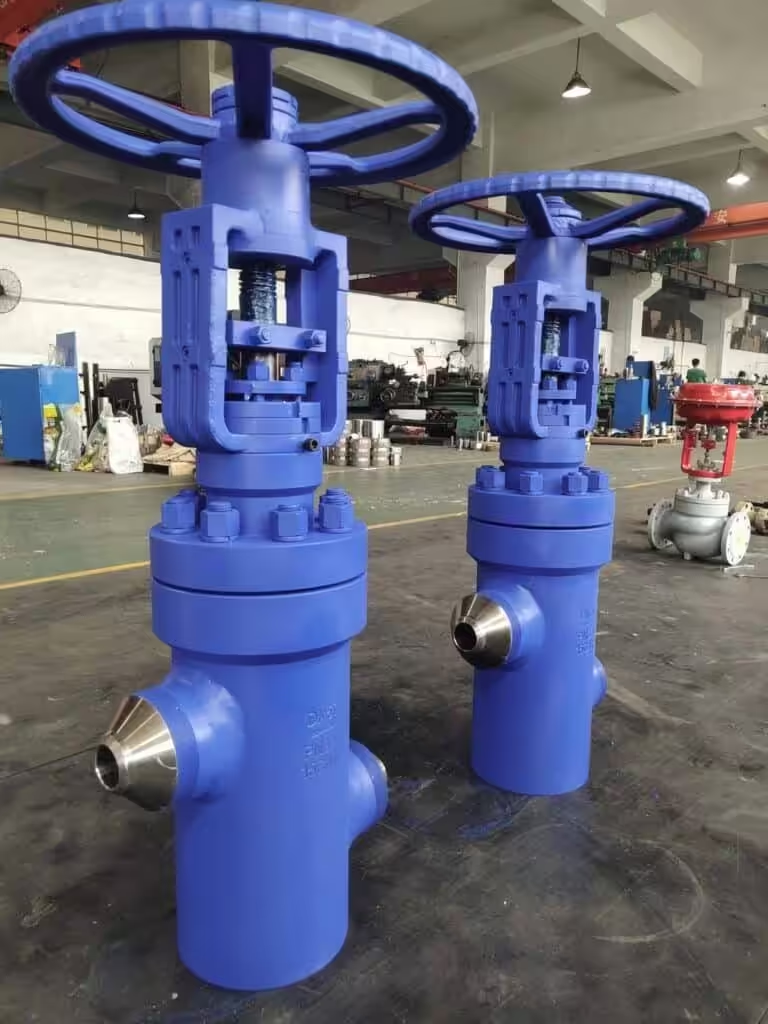
Some years ago, we supplied a batch of high-temperature and high-pressure manually operated pressure reducing valves. The valve body material was 15CrMo, the size was DN50, and the pressure rating was PN200.
During factory inspection, the valves passed hydrostatic testing. There was no leakage during the test. The documents looked normal. From the outside, nothing suggested a serious problem.
But after the valves arrived at the customer’s site, leakage was found.
We urgently recalled the valves and arranged further inspection. Radiographic testing later showed cracks in the valve bodies. The cracks were related to repair welding during the manufacturing process.
The original pressure test did not find them.
RT did.
For THINKTANK, this was a painful order. We lost money on the project. But we did not treat it only as a commercial loss. We worked with the customer, responded quickly, provided a corrective solution and after-sales support. The valves supplied after correction are now operating stably at the site.
More importantly, the project changed how we look at high-temperature valve body manufacturing.
It reminded us that valve reliability is not built by material selection alone. It is built by every process that comes after material selection.
The Material Name Is Visible. The Process Behind It Is Not.
When a buyer compares two valve quotations, many things look easy to compare.
- Material
- Size
- Pressure rating
- End connection
- Delivery time
- Price
But many of the most important quality factors are hidden.
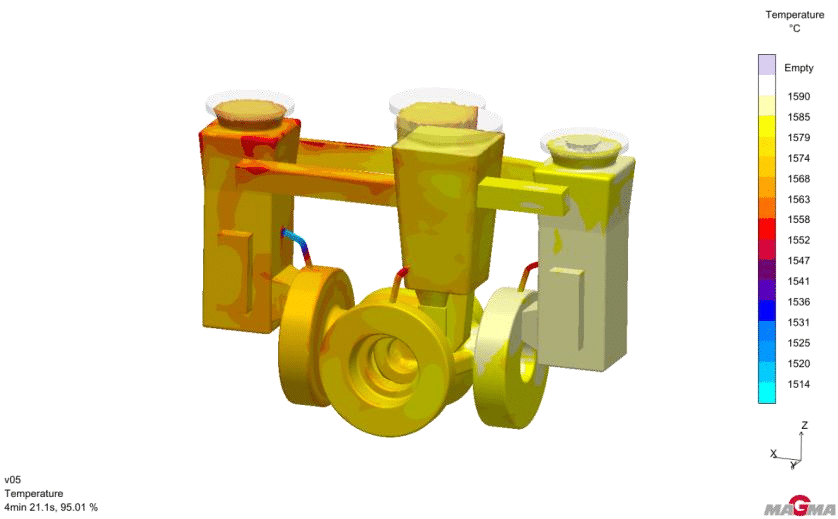
Was the body cast or forged?
If it was cast, was the casting properly cooled and heat-treated?
Was any repair welding performed?
Was the repair welding controlled by a qualified WPS?
Was preheating carried out correctly?
Was the interpass temperature controlled?
Was PWHT required and properly performed?
Were RT and UT performed on the valve body?
Were MT or PT used after repair welding?
Was the foundry capable of handling low alloy heat-resistant steel, or was it only selected because the price was lower?
These questions usually do not appear on the surface of the finished valve. They may not be visible after machining, painting, assembly, and packing.
But they decide whether a severe-service valve is only able to pass the factory test, or whether it can operate reliably on site. Selection should also start with current process conditions rather than the datasheet alone.
This is why two valves with the same material grade and pressure rating can have very different levels of reliability.

15CrMo Is Not Cr-Mo-V, But the Lesson Led Us Further
Technically, 15CrMo is a Cr-Mo low alloy heat-resistant steel. It contains chromium and molybdenum, but it does not contain vanadium.
Cr-Mo-V steels are different. They contain vanadium, which improves high-temperature creep strength through carbide precipitation. This makes them useful in demanding high-temperature applications such as steam systems, power plants, petrochemical units, and high-pressure valve or pipeline equipment.
So our 15CrMo project was not a Cr-Mo-V failure case in the strict chemical sense.
But it pushed us to study both Cr-Mo and Cr-Mo-V materials more deeply, because they share one important reality:
They are not ordinary carbon steels.
They may look like “just another alloy steel” on a material list, but their casting, welding, heat treatment, and inspection requirements are much more demanding.
For a valve manufacturer, knowing the material name is not enough.
We must understand how the material behaves during manufacturing.
Table 1. Typical Cr-Mo and Cr-Mo-V Heat-Resistant Steels Used in High-Temperature Service
| Steel Grade / Standard | C (%) | Cr (%) | Mo (%) | V (%) | Typical Industrial Applications |
| 20CrMo / GB/T 3077 | 0.17–0.24 | 0.80–1.10 | 0.15–0.25 | — | High-strength structural parts and conventional pressure components |
| 14MoV6-3 / EN 1.7715 | 0.10–0.15 | 0.30–0.60 | 0.50–0.70 | 0.20–0.30 | High-temperature piping, forgings, and flanges up to approximately 530°C |
| 21CrMoV5-7 / EN 1.7709 | 0.17–0.25 | 1.20–1.50 | 0.55–0.80 | 0.20–0.35 | Heat-resistant heavy forgings, bolting, and high-temperature pressure parts |
| C12A / ASTM A217 | 0.08–0.12 | 8.00–9.50 | 0.85–1.05 | 0.18–0.25 | High-temperature and high-pressure cast valve bodies for supercritical steam service |
The First Hidden Risk: Casting Control
Many people think that casting problems mainly mean sand holes, porosity, shrinkage, or inclusions.
These defects are real, and they are usually related to molding material, pouring system design, riser design, molten steel cleanliness, and foundry process control.
But for Cr-Mo and Cr-Mo-V low alloy heat-resistant steel valve bodies, there is another risk that is less visible: internal stress and brittle microstructure.
If a casting is opened too early, cooled too quickly, or not properly insulated and heat-treated, the surface and the core of the casting may cool at very different rates. The internal phase transformation may not happen uniformly. Residual stress can remain inside the valve body before machining even begins.
From the outside, the casting may still look normal.
After machining, the surface may look clean.
After painting, the valve may look perfect.
But internally, the valve body may already be sensitive.
Once repair welding is performed on this kind of casting, the welding heat may trigger cracking around the repaired area.
This is why repair welding cannot be treated as a simple workshop correction.

The Second Hidden Risk: Repair Welding
For some materials, repair welding may look like a normal production step.
- Remove the defect
- Weld it
- Machine it
- Continue production
But for Cr-Mo and Cr-Mo-V low alloy heat-resistant steels, repair welding is not just “adding metal back”.
It is a metallurgical operation.
The welding arc creates a local high-temperature zone. The surrounding valve body is much colder and much heavier. If preheating is insufficient, the heat affected zone may cool too quickly after welding.
For Cr-Mo steels, this can create a hard and brittle heat affected zone. If hydrogen is also present from moisture, welding consumables, or poor control, the combination of hard microstructure, hydrogen, and residual stress can lead to cold cracking.
These cracks may not appear immediately. They may appear hours later, days later, or only become visible during later inspection or service.
For Cr-Mo-V steels, the risk is even more severe. Vanadium is added to improve high-temperature strength, but after welding, V-bearing materials can be sensitive to reheat cracking, also called stress relief cracking. This may occur during PWHT or early high-temperature operation.
That is why these materials are not impossible to weld.
But they are unforgiving.
They require proper preheating, controlled heat input, interpass temperature control, low-hydrogen welding practice, qualified WPS, suitable PWHT when required, and final NDE.
Skipping one step may not show a problem immediately.
But the risk remains inside the valve body.
Table 2. ASME Section IX P-Number Classification and Welding Sensitivity
| ASME P-Number | Base Metal Alloy System | Typical ASTM Material Grades | Welding Sensitivity and Key Process Requirements |
| P-No. 1 | Carbon-manganese steels | ASTM A216 WCB/WCC, ASTM A105 | Relatively good weldability; PWHT may be exempted in certain thin-wall applications depending on code requirements |
| P-No. 4 | 1.25Cr-0.5Mo steels | ASTM A217 WC6, ASTM A182 F11 | Increased hardenability; controlled preheating and welding procedure control are required |
| P-No. 5A | 2.25Cr-1Mo steels | ASTM A217 WC9, ASTM A182 F22 | High welding sensitivity; strict preheating and PWHT are typically required |
| P-No. 5B | 5Cr to 9Cr Mo steels without vanadium | ASTM A217 C5, ASTM A217 C12 | Very high welding sensitivity; heat input, interpass temperature, and PWHT must be carefully controlled |
| P-No. 5C / 15E | Cr-Mo-V alloy steels | ASTM A217 C12A, ASTM A182 F91 | Extremely sensitive to welding thermal cycles; high risk of reheat cracking / stress relief cracking; strict WPS, PWHT temperature control, and NDE are required |
The Third Hidden Risk: Believing Hydrotesting Is Enough
Our 15CrMo project also taught us not to overestimate hydrostatic testing.
Hydrotesting is necessary. It confirms that the pressure boundary does not leak under a specific test condition.
But hydrotesting cannot see inside the metal.
If a crack is internal and has not fully penetrated the wall thickness, the test medium has no leakage path.
If a crack is tightly closed by residual stress, water may not enter it during the test.
If a defect is located in the heat affected zone but has not opened to the surface, the valve may still pass the pressure test.
This does not mean the pressure test is useless.
It means the pressure test has a boundary.
For high-temperature, high-pressure, or severe-service valve bodies, hydrotesting must be supported by suitable non-destructive examination.
RT can reveal many internal defects.
UT is especially important for detecting internal planar defects in thick sections.
MT is useful for surface and near-surface cracks in ferromagnetic materials.
PT can detect surface-opening defects where applicable.
Each method has its own role. None of them should be treated as a universal replacement for the others.
A serious inspection plan must consider material grade, wall thickness, repair history, pressure class, service condition, and failure consequence. This is also why customized valve solutions should begin with engineering data and real service conditions.
Table 3. Hydrotesting and NDE Methods for Valve Body Inspection
| Inspection / Testing Method | Principle / Test Method | Defects Effectively Detected | Key Limitations |
| Hydrostatic Pressure Test / API 598 | Pressurizes the valve body and seats with water or gas to verify pressure boundary and sealing performance | Through-wall leakage, gross pressure boundary failure, and seat leakage | Cannot reliably detect internal cracks, closed cracks, or defects that have not penetrated the wall thickness |
| Radiographic Testing / RT | Uses X-ray or gamma-ray radiation to inspect internal discontinuities through density variation on film or digital imaging | Internal porosity, slag inclusions, shrinkage cavities, and some open or favorably oriented cracks | Less sensitive to tightly closed planar cracks; detection depends on crack orientation and image quality |
| Ultrasonic Testing / UT | Uses high-frequency sound waves and reflected signals to detect internal discontinuities | Internal planar defects, lack of fusion, cracks, and flaws in thick sections | Requires skilled operators, suitable surface condition, and careful interpretation |
| Magnetic Particle Testing / MT | Uses magnetic flux leakage and magnetic particles to reveal surface or near-surface defects in ferromagnetic materials | Surface and near-surface cracks, laps, seams, and discontinuities | Only suitable for ferromagnetic materials; cannot detect deep internal defects |
| Liquid Penetrant Testing / PT | Uses capillary action of penetrant liquid to reveal surface-opening defects | Surface-opening cracks, pores, and discontinuities | Cannot detect subsurface or closed internal defects; surface preparation is critical |
Forged Bodies Help, But They Do Not Remove the Need for Control
After experiencing casting-related risks, many engineers prefer forged valve bodies for severe-service applications.
This makes sense.
Forging can improve internal density and reduce the risk of shrinkage, porosity, looseness, and other casting-related defects. It can also reduce the chance of repair welding before shipment.
For high-pressure and high-temperature valve bodies, forging can provide stronger confidence in base material integrity.
But forging does not change the chemical composition of the steel.
If a forged body is made from Cr-Mo or Cr-Mo-V steel, the welding sensitivity still exists.
If the valve requires butt-welding ends, seat hardfacing, overlay welding, or local repair welding, the same metallurgical rules still apply.
So the right conclusion is not “forging solves everything”.
The right conclusion is:
Forging reduces many physical defect risks, but it does not remove the need for welding discipline, heat treatment control, and NDE.
Table 4. High-Temperature and Low-Temperature Pressure-Retaining Materials
| Material Grade / Standard | Material Type / Microstructural Characteristic | Typical Minimum Design Temperature | Typical Maximum Service Temperature | Metallurgical Design Logic and Typical Applications |
| ASTM A216 WCB | Cast carbon steel | -29°C / -20°F | 425°C / 800°F | General-purpose cast steel for water, oil, gas, and conventional process service |
| ASTM A352 LCB / LCC | Low-temperature cast carbon / carbon-manganese steel | -46°C / -50°F | 345°C / 650°F | Low-carbon design with improved low-temperature toughness; used for cold service, low-temperature piping, and pressure equipment |
| ASTM A352 LC3 | 3.5% nickel low-temperature cast steel | -101°C / -150°F | 340°C / 650°F | Nickel alloying improves low-temperature toughness; used for more severe cryogenic or low-temperature applications |
| ASTM A217 C12A | 9Cr-1Mo-V cast steel | -29°C / -20°F | 649°C / 1200°F | Vanadium-containing martensitic heat-resistant steel for high-temperature, high-pressure steam valves and supercritical power service |
Why the Same Valve Can Have a Different Price
This is the part many buyers do not see.
A cheaper valve may use the same material name.
It may have the same pressure rating.
It may pass the same hydrostatic test.
It may even look the same after painting.
But the hidden process control may be completely different.
One supplier may require strict casting control, heat treatment records, repair welding approval, WPS control, PWHT records, RT, UT, MT, and PT where necessary.
Another supplier may only focus on machining, assembly, and final pressure testing.
The difference is not always visible at delivery.
But it is real.
RT and UT cost money.
PWHT costs money.
Qualified welding procedures cost money.
Rejecting a defective casting costs money.
Using a more capable foundry costs money.
Slower cooling, better heat treatment, and stricter inspection all cost money.
But these costs are part of reliability.
When a valve is used in mild service, some requirements may not be necessary. But in high-temperature, high-pressure, and severe-service applications, removing these controls to reduce cost may only move the risk from the factory to the customer’s site.
That is not cost saving.
That is risk transfer.
What THINKTANK Changed After This Project
After the 15CrMo PN200 pressure reducing valve project, we strengthened our internal quality standards for low alloy heat-resistant steel valve bodies.
For critical applications, RT and UT are no longer treated only as optional customer requirements. Depending on material, wall thickness, pressure class, repair history, and service condition, they can become our internal mandatory requirements even when the customer does not specifically request them.
We also became stricter with casting suppliers.
We pay more attention to whether they understand low alloy heat-resistant steel, not only whether they can pour the material. Cooling control, heat treatment records, defect repair history, and NDE reports became more important in our supplier evaluation.
For repair welding, we pay more attention to whether the welding process is controlled by procedure, not only by experience. Preheating, interpass temperature, low-hydrogen practice, PWHT records, and inspection after repair are now treated as part of the real quality route.
This experience also changed our internal mindset.
A valve body is not qualified only because it passed the final pressure test.
It is qualified because the critical processes before the pressure test were controlled.

A Supplier’s Responsibility Is Revealed When Problems Happen
No manufacturer wants to talk about a failed project.
But I believe real experience should include both success and failure.
That 15CrMo order cost us money, but it gave us something more valuable: a deeper understanding of manufacturing risk.
We responded to the customer.
We solved the problem.
We improved our internal standards.
And the corrected valves are now operating stably at the site.
This is important to us, because a supplier’s responsibility is not only shown when everything goes smoothly.
It is shown when a problem appears.
Do we respond quickly?
Do we face the root cause honestly?
Do we improve the process, or only replace the product?
Do we turn one painful lesson into a better standard for the next customer?
For THINKTANK, this project became part of our quality philosophy.
Material Selection Is Only the Beginning
After 18 years in the valve industry, I still feel that there is much more to learn.
The deeper we go into valve manufacturing, the more we understand that an industrial valve is not a simple product.
A reliable severe-service valve is not created only by choosing the right material.
It is built through casting control, forging quality, welding discipline, heat treatment, inspection planning, supplier management, and engineering responsibility.
These things are not always visible from the outside.
They may not be obvious in a quotation.
They may not be noticed during a factory visit.
But they are hidden inside the valve.
And when the valve is installed on a real site, under real pressure, real temperature, and real operating conditions, these invisible controls become visible through performance.
This is why THINKTANK continues to study materials, improve supplier management, and strengthen inspection requirements.
Because in severe-service valves, reliability is not only about what material is selected.
It is about how every process behind that material is controlled.