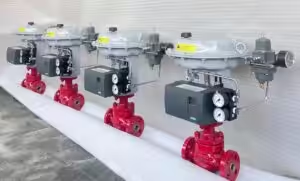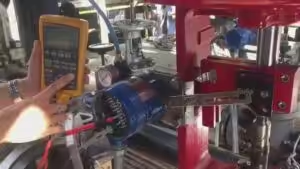
We don’t sell the cheapest valves. We sell lower project risk, stronger support, and a team that stands behind every order.
If you are comparing our price with other suppliers, I invite you to take a few minutes to read this article. It explains what is really included in a THINKTANK valve price and may help you avoid hidden project costs from premature replacement later.
In short: You are not only paying for a valve. You are paying for engineering review of the required process data, technical documents, application-specific customization, problem solving, and someone who will stand behind the project when something goes wrong.
As the founder of THINKTANK, I know very well:
Our valves are not the cheapest in the market.
And honestly, they are not supposed to be.
Every time a customer tells us, “Your price is higher than others,” I actually see it as a good sign. It means:
- You are serious about this project.
- You are considering us as a real option.
- You just need a clear, reasonable explanation of what you are really paying for.
If we cannot explain this well, you have every reason to buy from someone else.
So in this article, I want to tell you directly, from the founder’s point of view:
what is behind THINKTANK’s price, and why many engineers still choose us even when our quote is not the lowest.
1. The cheapest valve can become the most expensive
We often say inside our team:
“The cheapest product becomes expensive when you can’t get the service.”
On paper, a valve is just a line in a BOM, a number in an Excel file. But in real projects, what really costs money is not only the valve itself, but also:
- redesign, rework, and delays,
- site problems,
- miscommunication with end users,
- and the time engineers have to spend fixing issues that should not happen.
When something goes wrong, you don’t just pay for a new valve.
You pay with shutdown time, client trust, and your reputation with the end user.
Our goal at THINKTANK is simple:
If you buy our valve, don’t worry about the rest.
If there is any problem, THINKTANK will stand behind it.
This “don’t worry about the rest” is already included in our price.
2. What is included in THINKTANK’s price (besides the valve itself)
We are not only selling a product code and a piece of metal.
When you receive a quotation from THINKTANK, inside that price you are also getting:
2.1 Engineering detail and technical support
Before an order, we spend time on:
- checking process data,
- reviewing datasheets,
- matching or replacing existing brands,
- making drawings and technical files for your approval,
- discussing material, face-to-face length, connection standards, etc.,
- identifying potential risks in the selection (wrong Cv, pressure class, cavitation, noise, corrosion, etc.) and proposing safer alternatives,
- offering customized configurations to match your preferred brands of actuators, positioners, and accessories, so the solution fits your plant standard.
Sometimes these steps look “invisible”, but they prevent many project mistakes.
If another supplier just sends a cheap price without doing this, it may look attractive at first, but the project risk is on you.
2.2 Service and documentation during the project
Many customers only realize service value when something changes:
- you need NDT or additional material tests,
- you need new certificates,
- the paint standard must be changed to match a project spec,
- the end user suddenly asks for extra documents, drawings, 3D Models, CFD Analysis, FEM Analysis
We have seen this many times:
Clients place an order with basic requirements. After the PO, they come back with:
- ultrasonic / radiographic testing requests,
- extra mechanical / chemical tests, PMI, impact tests,
- new painting systems or color codes according to another standard.
Strictly speaking, these items are outside the original scope.
But as long as it is within our capability, we do our best to cover it and help the customer solve the problem, instead of saying, “This is not included, please handle it yourself.”
We do not add a huge hidden cost in our price just because “something might change later”.
We know you have already signed a contract with your end user, and when new requirements appear, time is tight and pressure is high.
In that situation, if we can help you close the gap and keep the project on track, we will try our best to do it.
This flexibility and willingness to support you under pressure are also part of the value behind our price.
2.3 Customization instead of “catalog only”
Many projects are not “standard catalog” jobs.
We are willing to do more customized work, for example:
- special materials,
- special face-to-face lengths to match existing valves,
- adapted trims or sealing structures,
- special accessories or connections based on client or end user requirements.
This kind of customization brings extra engineering work, internal discussion, and risk control on our side.
At the same time, even when the valve is a standard catalog size with the same face-to-face and pressure class as other brands, our approach is still not “just ship whatever fits the drawing”.
We keep our own internal standards for:
- how the trims are designed and machined,
- how tight the tolerances and clearances are,
- what level of testing and inspection is done,
- how materials and batches are controlled and traced.
So if a quotation looks higher, very often it is because we have already counted in this real project workload and internal quality standard, not just a bare unit cost of a valve body.
2.4 Same drawing, different valve – the invisible details
Even when two suppliers offer the same product type and the same drawing, there are still many details you cannot see from the datasheet:
- Surface roughness of sealing and guiding parts
- Machining accuracy and matching tolerances
- How the internal flow path is processed and deburred
- Assembly process, torque control, and cleaning standard
- Internal design details that are not fully shown on a simple drawing
- Real material quality and stability of each small component
- Inspection standards and how strictly they are implemented
All these details mean different production costs.
On paper, the model and drawing may look “the same”.
But in real operation, you may see a big difference in:
- leakage performance,
- service life,
- actuator load,
- and how often you need to repair or replace the valve.
So when two quotations look similar on the drawing level but have a clear price gap,
very often the gap comes from these invisible quality details, not from “someone earning more margin for nothing”.
3. Responsibility: we are not afraid of problems
In real projects, problems sometimes happen — with any brand.
The difference is: what happens after the problem appears?
Our attitude is very clear:
We are not afraid of any problem.
We are only afraid that the customer doesn’t tell us the problem.
If there is an issue, we join you to solve it, not to push it away.
- We analyse the root cause together.
- We provide technical suggestions and corrective actions.
- If we are responsible, we take responsibility directly.
- Even if it is not fully our fault, we often still share part of the loss to help you reduce the damage.
This is also part of the “price” you see in our quotation.
4. A real case: sharing loss even when it was not our mistake
Let me give you one real example.
We once had a project with an overseas solution company.
Before production, we:
- provided complete technical documents and drawings,
- received their official stamp and signature on all drawings and datasheets.
Later, after delivery, it turned out that:
- they had not properly coordinated with the end user,
- the face-to-face length did not match the original Flowserve valve,
- the material did not follow the original design on site.
From a technical and contractual point of view, the responsibility was clearly on their side.
All drawings and specs were confirmed by them before manufacturing.
However, to reduce the project loss and keep the end user’s system safe, we still decided to:
- refund 50% of the valve value, even though we had no technical error.
At the same time, we also protected our own business and brand:
- we marked this company in our internal system as “do not quote again”;
- we signed a written agreement, stamped by the customer, clearly stating that
“ these two valves must be scrapped and are not allowed to be delivered, installed, or used in any end-user project, and”
“we will not provide any future service or technical support for these two valves.“
This case shows two important points:
- We are willing to share loss with responsible partners – even when it is not fully our fault, as long as it helps to protect the project and the end user.
- We also choose our customers – we do not continue to work with companies that are not professional or not responsible to their end users.
Both attitudes are reflected in how we price our products and how we work with our partners.
5. Direct access to the founder – not just a salesperson
Another point that is very different from many competitors:
I am the founder of THINKTANK.
Any sales, solution, or after-sales problem can be escalated directly to me.
I am not in front-line sales every day, but:
- all key issues are reported to me,
- I personally join the discussion and decision,
- customers can email or call me directly, 24/7.
In many other companies, you only talk to a salesperson who:
- may not have the authority to decide,
- may not have the technical background to solve real problems quickly.
With THINKTANK, if something serious happens, you know exactly who is standing behind the product.
This “direct access to the person who can decide” is also part of the value you pay for.
6. So, why is THINKTANK’s price higher than some competitors?
If we put everything together, the answer is simple:
You are not only paying for
- a valve,
but also for
- detailed engineering review and risk checking,
- technical documents, drawings, and modeling support,
- flexibility when new end-user requirements appear,
- willingness to customize instead of “catalog only”,
- internal quality standards and invisible details that are not shown on a simple drawing,
- a problem-solving attitude and shared risk when something goes wrong,
- direct involvement of the founder when needed.
If you only compare unit price on a spreadsheet, we may lose.
If you compare total project cost, risk, and how smoothly your project runs, many partners understand why they still choose THINKTANK.
7. A simple message to customers who feel our price is high
If one day you feel our price is higher than another supplier, I hope you can remember three things:
- Ask not only “how much is the valve”, but also “what happens if something goes wrong?”
- Think about the cost of no service, no support, and no responsibility when the end user changes requirements.
- Remember: the cheapest valve can easily become the most expensive part of your project.
At THINKTANK, we don’t promise to be the cheapest.
We promise to be professional, responsible, and on your side when you really need us –
with real engineering work behind the product, and a team that will stand behind every order.
If you want to discuss a project or have any concern about price versus value, you are always welcome to talk to us.