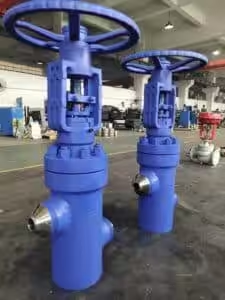
From an engineering perspective, ISO 5208 is not just a testing standard — it is a common technical language between valve manufacturers, EPC contractors, inspectors, and end users.
In our daily work at THINKTANK, we see many projects where pressure tests and sealing tests are performed, but the intent behind the test is not fully understood.
Questions such as:
- Why is a high-pressure sealing test required for some valve types but optional for others?
- What does “no visible leakage” actually mean under ISO 5208 acceptance criteria?
- How should leakage classes be selected and specified on purchase orders?
- How do we determine DN when the valve size is not marked as DN?
ISO 5208 provides clear answers to these questions — if it is read and applied correctly.
In this article, we walk through the key parts of ISO 5208 related to pressure testing, sealing test methods, leakage acceptance criteria, and equivalent DN determination, not by repeating the standard text, but by explaining how engineers actually apply it in real projects.
1.1.1 Scope
This standard specifies the examinations and tests that valve manufacturers shall perform in order to verify the pressure boundary integrity of industrial metallic valves, the degree of tightness of the valve in the closed position, and the structural suitability of the closing mechanism.
This standard is intended to be used in conjunction with the applicable valve product standards (including standards referenced therein). Where the requirements of the product standard differ from those of this standard, the requirements of the product standard shall apply.
This standard does not address safety aspects related to pressure testing.
1.1.2 Terms and Definitions
1.1.2.1 Shell Test
A test conducted at a pressure exceeding the valve’s cold working pressure (CWP) (see 1.1.2.9), intended to verify the pressure-retaining integrity and structural strength of the valve pressure boundary.
1.1.2.2 Seat Tightness Test
A pressure test used to verify leakage through the valve sealing mechanism when the valve is in the closed position.
1.1.2.3 Test Pressure
The internal pressure applied to the valve during testing, expressed in bar gauge (barg).
Note 1: Unless otherwise specified, all pressures in this standard are gauge pressures.
Note 2: 1 bar = 10⁵ Pa.
1.1.2.4 Test Fluid
The pressurizing liquid or gas used for valve pressure tests and sealing tests.
1.1.2.5 Test Fluid Temperature
The temperature of the test fluid shall be not less than 5 °C and not greater than 40 °C.
1.1.2.6 Resilient Seat
Valve seat sealing materials forming a flexible sealing combination, including elastomeric materials, polymers, and solid or semi-solid grease seals, which may be used alone or in combination with mating metallic or ceramic components.
1.1.2.7 DN, NPS, A (Nominal Size)
DN, NPS, and A are nominal size designations commonly used for piping system components and are intended for reference purposes only.
The dimensionless number following DN or NPS, or preceding the letter A, indirectly relates to the actual dimensions of the end connection bore or outside diameter.
Note: The numbers associated with DN, NPS, or A do not represent measured values and shall not be used for calculation purposes unless otherwise specified in the product standard.
1.1.2.8 PN or Class (Nominal Pressure)
PN or Class are pressure–temperature rating designations commonly used for piping system components and are intended for reference purposes.
The dimensionless number following PN or Class indirectly relates to the pressure capability of the component as a function of temperature.
Note: The numbers associated with PN or Class do not represent measured values and shall not be used for calculation purposes unless otherwise specified in the product standard. No fixed relationship exists between PN and Class designations.
1.1.2.9 Cold Working Pressure (CWP)
The maximum fluid pressure at which the valve is operated when the fluid temperature is between −20 °C and 38 °C.
This definition is based on standard ambient temperature conditions and does not represent the valve’s maximum allowable pressure at elevated temperatures.
1.1.2.10 Design Differential Pressure
The maximum pressure difference across the inlet and outlet sealing elements when the valve is in the closed position.
1.1.2.11 Double Block and Bleed Valve (DBB)
A valve having two independent seating surfaces which, in the closed position, block flow from both ends, with a bleed port between the seating surfaces.
The bleed port may be connected to piping or piping components, installed temporarily or permanently, to allow verification of sealing integrity.
1.1.3 Conditions Related To Pressure Testing
1.1.3.1 Purchaser’s Inspection Options
a) The purchaser may specify, in the purchase order, the valve inspection and pressure test requirements, including whether inspections or tests are to be witnessed, and the required notification period.
During these activities, the purchaser’s representative shall be permitted to enter the manufacturer’s works and access the areas related to valve inspection and pressure testing, as specified in the purchase order.
b) When the purchaser specifies witnessing of inspections or tests in accordance with 1.1.3.1 a), the valve manufacturer shall notify the purchaser at least five working days prior to the scheduled activity, unless otherwise agreed in the purchase order.
1.1.3.2 Witnessing On Site
When pressure testing specified by the purchaser’s representative is performed on stock valves, valves that have already been painted or coated may be retested without removal of the external paint or coating, unless otherwise specified in the purchase order.
1.1.3.3 Seat Test Options
The purchaser may specify any seat test option in the valve purchase order; see Table 1-1 for applicable test requirements.
1.1.4 Pressure Test Requirements
1.1.4.1 Precautionary Warning
Users of this standard shall give due consideration to the hazards associated with pressurized gases and liquids.
1.1.4.2 Location
Pressure testing shall be performed at the valve manufacturer’s works, or at a test facility under the valve manufacturer’s supervision and responsibility.
1.1.4.3 Test Equipment
a) The test equipment shall be arranged so that it does not subject the valve to external forces that could affect the test results.
When end clamping devices are used, the manufacturer shall be able to demonstrate that such devices do not reduce minor leakage during seat testing.
For valves installed between flanges, such as wafer-type check valves or butterfly valves, the clamping force applied by the test equipment shall not be so great that it affects the pressure test results.
b) When using equipment such as volumetric loss measuring devices, the manufacturer shall be able to demonstrate that the system provides equivalent measurement capability and accuracy to the requirements of this standard.
1.1.4.4 Pressure-Measuring Equipment
The equipment used to measure test fluid pressure shall be capable of measuring the required test pressure to an accuracy of ±5%.
1.1.4.5 Shell Surface
Before the shell test, the valve shall not be externally painted or coated with materials intended to prevent leakage from the external shell surface.
However, valves with internal liners, internal coatings, or internal claddings forming part of the valve’s internal structural characteristics may be tested with such liners, coatings, or claddings in place.
If the purchaser specifies that shell tests be repeated on valves that have already been painted, removal of the external paint or coating is not required during the repeat test.
1.1.4.6 Test Fluid
In accordance with the relevant test specifications described in this standard, suitable test fluids shall be:
— water, which may contain corrosion inhibitors, kerosene, or other suitable liquids with a viscosity not greater than that of water;
— air or other suitable gases.
The test fluid temperature shall be between 5 °C and 40 °C.
For valves with austenitic stainless steel bodies, when water is used as the test fluid, the chloride content shall not exceed 100 × 10⁻⁶.
1.1.4.7 Test Pressure
Except for low-pressure seat tests, the test pressure is related to the valve cold working pressure (CWP).
During testing, the applicable test pressure shall also take into account the valve body material, as specified in this standard.
1.1.4.8 Pressure Tests
a) Pressure tests shall comply with the requirements of this standard:
① The required tests listed in Table 1-1 shall take into account the exceptions and notes specified in 1.1.4.8 c).
② Tests required by the applicable valve product standard are listed in Table 1-1 as optional items.
③ Pressure tests shall be performed in accordance with written procedures established by the valve manufacturer in compliance with this standard.
b) As shown in Table 1-1, if the purchaser specifies any optional test, that test shall be performed in addition to the tests required by Table 1-1.
c)The following notes and exceptions to Table 1-1 apply:
① For plug valves that rely on sealing compound to effect the closure seal, a high-pressure closure test is required; the low-pressure closure test is optional.
② In the case of bellows stem sealed valves, a backseat test is not required.
③ For double block and bleed (DBB) valves, a high-pressure closure test is required; the low-pressure closure test is optional.
d) For certain tests, the test duration and seat leakage rate are determined based on DN. For valves without DN marking, the corresponding DN shall therefore be identified before testing.
For valves with flanged ends, threaded ends, welded ends, capillary tubing ends, or reducer ends, the corresponding DN shall be as shown in Table 1-1.
Table 1-1 Specified Pressure Tests
| Test | DN | PN Or Class | Gate Valve | Globe Valve | Plug Valveᵃ | Check Valve | Floating Ball Valve Or Diaphragm Valve | Butterfly Valve Or Trunnion-Mounted Ball Valve |
|---|---|---|---|---|---|---|---|---|
| Shell Test — Liquid Test | All | All | Mandatory | Mandatory | Mandatory | Mandatory | Mandatory | Mandatory |
| Shell Test — Gas Test | All | All | Optional | Optional | Optional | Optional | Optional | Optional |
| Backseat Testᵇ,ᶜ — Liquid Test | All | All | Optional | Optional | Not Required | Not Required | Not Required | Not Required |
| Sealing Test — Low-Pressure Gas Test | DN ≤ 100 | Class ≤ 1500 And PN ≤ 250 | Mandatory | Optional | Mandatory | Optional | Mandatory | Mandatory |
| Sealing Test — Low-Pressure Gas Test | DN ≤ 100 | Class > 1500 And PN > 250 | Optional | Optional | Optional | Optional | Mandatory | Optional |
| Sealing Test — Low-Pressure Gas Test | DN > 100 | Class ≤ 600 And PN ≤ 100 | Mandatory | Optional | Optional | Optional | Mandatory | Mandatory |
| Sealing Test — Low-Pressure Gas Test | DN > 100 | Class > 600 And PN > 100 | Optional | Optional | Optional | Optional | Mandatory | Optional |
| Sealing Test — High-Pressure Liquid Test | DN ≤ 100 | Class ≤ 1500 And PN ≤ 250 | Optional | Mandatory | Optional | Mandatory | Optional | Optional |
| Sealing Test — High-Pressure Liquid Test | DN ≤ 100 | Class > 1500 And PN > 250 | Mandatory | Mandatory | Mandatory | Mandatory | Optional | Mandatory |
| Sealing Test — High-Pressure Liquid Test | DN > 100 | Class ≤ 600 And PN ≤ 100 | Optional | Mandatory | Optional | Mandatory | Optional | Optional |
| Sealing Test — High-Pressure Liquid Test | DN > 100 | Class > 600 And PN > 100 | Mandatory | Mandatory | Mandatory | Mandatory | Optional | Mandatory |
ᵃ For plug valves that achieve closure sealing by means of sealing compound, the sealing test shall be performed with the sealing compound installed.
ᵇ Successful completion of a backseat test shall not be construed as a recommendation by the valve manufacturer that, when an installed valve uses the backseat under pressure, the stem sealing may be adjusted, repaired, or replaced.
ᶜ In the case of bellows stem sealed valves, a backseat test is not required.
Notes:
This effect is related to the deformation characteristics of resilient sealing materials under high differential pressure and shall be considered when defining test sequences and acceptance criteria.
- Successful completion of an optional test does not replace, or guarantee compliance with, the mandatory test requirements.
- For valves with resilient seats, a high-pressure sealing test may reduce the sealing performance in subsequent low-pressure service.
e) Optional use of gas as the test fluid for the shell test may be specified in the valve purchase order.
To safely carry out this test, appropriate precautionary measures are essential; see 1.1.4.1.
1.1.4.9 Conformity Of Sealing Tests
For valve types for which the high-pressure sealing test is listed as optional in Table 1-1, the valve shall still be designed and manufactured such that it is capable of passing the high-pressure sealing test, as this test verifies the structural capability of the valve sealing arrangement.
When specified in the valve purchase order, the results of the high-pressure sealing test, used to verify the structural capability of the valve sealing arrangement, shall be provided as part of the test documentation.
1.1.4.10 Shell Test
1) Test Fluid For Shell Test
① For mandatory shell tests listed in Table 1-1, the test fluid shall be water or a liquid complying with the requirements of 1.1.4.6.
② For optional shell tests listed in Table 1-1, the test fluid shall be a gas complying with the requirements of 1.1.4.6; see also 1.1.4.8 e).
2) Shell Test Procedure
① The stem sealing shall be in place; if adjustable, it shall be adjusted to a condition suitable for the shell test pressure.
② The closure member shall be in the partially open position.
③ All valve end connections shall be closed and shall comply with the requirements of 1.1.4.3.
④ All internal cavities of the valve shall be completely filled with the test fluid.
⑤ The pressure shall be gradually increased to the shell test pressure specified in 1.1.4.10 (3).
⑥ During the test, the shell test pressure shall be maintained for not less than the time specified in Table 1-2.
⑦ A visual examination of the entire external surface of the valve shell shall be performed.
⑧ When the test fluid is liquid, the external surface of the valve shell shall be visually examined for leakage.
⑨ When the test fluid is gas, the external surface of the valve shell shall be coated with a leak-detection solution or submerged in water to a depth not exceeding 50 mm below the surface, and examined for the formation of continuous bubbles.
3) Shell Test Pressure Requirements
① When the test fluid is liquid, for mandatory shell tests, the shell test pressure shall be not less than 1.5 times the cold working pressure (CWP).
② When the test fluid is gas, for optional shell tests, the shell test pressure shall be not less than 1.1 times the cold working pressure (CWP).
When an optional gas shell test is required, a mandatory liquid shell test without hazard shall be performed first in order to verify the pressure-retaining capability of the valve structure; see 1.1.2.1.
4) Shell Test Duration
The shell test duration shall be not less than the values specified in Table 1-2.
Table 1-2 Minimum Duration Of Pressure Tests
| Nominal Size | All Valves — Shell Test (s) | Optional Backseat Test (s) | Sealing Test — Isolation Valves (s) | Sealing Test — Check Valves (s) |
|---|---|---|---|---|
| DN ≤ 50 | 15 | 15 | 15 | 60 |
| 65 ≤ DN ≤ 150 | 60 | 60 | 60 | 60 |
| 200 ≤ DN ≤ 300 | 120 | 60 | 120 | 120 |
| DN ≥ 350 | 300 | 60 | 120 | 120 |
Notes:
a) The test duration is the time during which the valve is fully prepared and subjected to the test pressure for inspection.
b) See 1.1.4.8 (2).
5) Acceptance Criteria For Shell Test
① When the test fluid is liquid, any visible leakage from any external surface of the valve shell detected by visual examination shall constitute rejection.
② When the test fluid is gas, any continuous formation of bubbles on any external surface of the valve shell or leak-detection coating while submerged in water shall constitute rejection.
When the test fluid is liquid, if no visually detectable leakage is observed at the stem sealing when the test pressure reaches 1.1 times the cold working pressure, stem sealing leakage is acceptable.
When the test pressure is then increased to the full shell test pressure, verification shall first be completed.
1.1.4.11 Optional Backseat Test
1) General
For valves having this design feature, when the optional backseat test is specified in the valve purchase order, the backseat test shall be performed in accordance with the requirements of this clause.
2) Test Fluid For Backseat Test
The test fluid for the backseat test shall be water or a liquid complying with the requirements of 1.1.4.6.
3) Recommended Backseat Test Procedure
① The stem sealing shall be adjusted so that its effect on the operating force applied to the valve stem is eliminated.
② The backseat shall be closed.
③ All valve end connections shall be closed and shall comply with the requirements of 1.1.4.3.
④ All internal cavities of the valve shall be completely filled with the test fluid.
⑤ The pressure shall be gradually increased to the value specified in 1.1.4.11 (4).
⑥ The test pressure shall be maintained for not less than the duration specified in Table 1-2.
⑦ A visual inspection shall be carried out at the interface between the valve shell and the stem sealing.
⑧ When a backseat test has already been performed either before or after the shell test, appropriate restoration of the stem sealing adjustment shall be carried out.
4) Backseat Test Pressure
The backseat test pressure shall be 1.1 times the cold working pressure (CWP).
5) The backseat test pressure shall be maintained for not less than the duration specified in Table 1-2.
6) Backseat Test Acceptance Criteria:
No visible leakage shall be observed at the interface between the valve shell and the stem sealing during the backseat test.
Engineering Clarification
The optional backseat test defined in ISO 5208 is intended solely to verify the integrity of the backseat sealing interface under test conditions.
Successful completion of this test does not imply that the backseat may be relied upon during normal operation, nor does it authorize stem sealing adjustment, repair, or replacement while the valve is pressurized.
Any maintenance practices involving the use of the backseat under pressure shall be governed by the applicable valve product standard, manufacturer instructions, and site safety procedures.
1.1.4.12 Sealing Test
1) General Requirements
① Sealing Surface Condition
Except for plug valves that rely on sealing compound to achieve closure sealing, the sealing surfaces shall be clean and free from oil, grease, or composite materials that could be used to reduce leakage.
However, where necessary to prevent surface damage due to metal-to-metal contact, these surfaces may be coated with a light oil having a viscosity not greater than that of kerosene.
② Leakage Paths Behind Seats
Any leakage detected behind the valve seat sealing ring, through the valve body cavity, or around internal or resilient sealing materials shall constitute rejection.
③ Valve Cavity Filling Requirement
For valves with a cavity between the valve body and bonnet, such as gate valves, ball valves, or plug valves, the sealing test shall be performed with the valve cavity completely filled with the test fluid.
This is to ensure that leakage measurement is not affected by an incompletely filled cavity.
2) Test Fluid For Sealing Test
The test fluid for both mandatory and optional sealing tests listed in Table 1-1 shall comply with the requirements of 1.1.4.6, and shall be water, another suitable liquid, or gas.
When liquid is used as the test fluid, the valve cavity shall be substantially free of air while in the test condition.
3) Leakage Detection
① Standard leakage detection method
Except for double block and bleed valve designs (see Table 1-3), the test pressure shall be applied to one side of the closed valve, and leakage shall be checked on the opposite side, which shall be open to atmosphere.
② Alternative leakage measurement devices
As an alternative to the method described in 1.1.4.12 (3)①, a suitable leakage measurement device may be used, provided that:
a) the measurement accuracy is consistent with the acceptance criteria for sealing test leakage;
b) the valve manufacturer is able to demonstrate and confirm that the results obtained by this procedure are equivalent to those required by 1.1.4.12 (3)①.
③ Volumetric (bubble counter) method
As an alternative to 1.1.4.12 (3)①, a fluid volumetric measurement device (commonly referred to as a bubble counter) may be used, provided that the following conditions are met:
a) The measurement accuracy shall be consistent with the acceptance criteria for sealing test leakage;
b) The valve manufacturer shall be able to demonstrate and confirm that the results obtained by this procedure are equivalent to those required by 1.1.4.12 (3)①;
c) The manufacturer’s test procedure shall require the volumetric measurement device to be calibrated and used at the same temperature as the sealing test fluid;
d) The manufacturer’s test procedure shall require that the test duration commence only after the test medium passing through the test piping has been verified as stable;
e) For valves with nominal size DN > 50, the method for determining sealing test leakage rates shall be specified by the purchaser in the valve purchase order.
4) Sealing Test Pressure
① Standard sealing test pressures
Except as specified in 1.1.4.12 (4)② and 1.1.4.12 (4)③, the sealing test pressure shall be as follows:
a) When the test fluid is gas, the sealing test pressure shall be 6 bar ± 1 bar;
b) When the test fluid is liquid, the sealing test pressure shall be not less than 1.1 times the cold working pressure.
② Combination check valves
For combination check valves equipped with mechanical, fluid-powered, or electrically actuated assisted closing mechanisms, the mandatory high-pressure sealing test shall be conducted at 110% of the design differential pressure.
The manufacturer’s nameplate shall include the limiting value of the design differential pressure.
③ Reduced sealing test pressure
Because closure actuating devices (direct, mechanical, fluid-powered, or electric) may be damaged or rendered inoperative under high differential pressure conditions, the operating conditions of the valve may be limited to a differential pressure lower than the rated cold working pressure.
In such cases, the sealing test may be performed at a pressure lower than that specified in 1.1.4.12 (4)①b), provided that this exception is agreed upon by both the valve manufacturer and the purchaser.
In this case, the sealing test pressure shall be 1.1 times the design differential pressure, and the limiting value of the design differential pressure shall be stated on the nameplate.
5) Sealing Test Duration
The sealing test pressure shall be maintained for not less than the duration specified in Table 1-2.
6) Sealing Test Procedure
The test methods and inspection requirements for the main valve types shall comply with the provisions of Table 1-3.
Table 1-3 Sealing Test Methods By Valve Type
| Valve Type | Test Method |
|---|---|
| Gate Valve Ball Valve Plug Valve | Close both ends of the valve. Position the closure member in the partially open position. Fill the valve internal cavity with the test fluid. Gradually increase pressure to the specified test pressure. Close the closure member. Maintain the test pressure on one end for the specified duration, release pressure on the opposite end, and check for leakage at the pressurized end. Repeat the procedure with the valve flow direction reversed and perform the sealing test and inspection on the opposite end. See Note 1. |
| Globe Valve Diaphragm Valve | Close the valve end that is unfavorable to seat sealing. Close the closure member. Fill the valve internal cavity with the test fluid. Gradually increase pressure to the specified test pressure. Check for leakage at the opposite end. |
| Butterfly Valve | Close one end of the valve. Close the closure member. Fill the valve internal cavity with the test fluid. Gradually increase pressure to the specified test pressure. Maintain the test pressure unchanged for the specified duration. Check for leakage at the opposite end. Repeat the above procedure with the valve flow direction reversed. See Note 2. |
| Check Valve | Position the check valve in the fully closed condition. Seal the outlet end of the check valve. Fill the valve internal cavity with the test fluid. Gradually increase pressure to the specified test pressure. Check for leakage at the inlet end. |
| Double Block And Bleed (DBB) Structure | Close the valve closure member. Fill the internal cavity on one side of the valve with the test fluid. Gradually increase pressure to the specified test pressure. Maintain the test pressure unchanged for the specified duration. Check for leakage at the bleed port between the two valve seats. Repeat the procedure with the valve flow direction reversed and test the opposite side. See Note 3. |
| Single-Direction Sealing Structure | Close the valve closure member. Seal both ends of the valve according to the flow direction indicated on the valve marking. Fill the valve with the test fluid. Gradually increase pressure to the specified test pressure. Maintain the test pressure unchanged for the specified duration. Check for leakage at the opposite end. See Note 4. |
Note:
- Valves with independent double sealing arrangements, such as double-disc gate valves or combined closure-member valves, shall be tested by applying pressure between the two valve seats and checking leakage on each side of the closed valve.
2. Butterfly valves have symmetrical seats; therefore, identical sealing capability exists in either flow direction, and testing may be carried out in either direction.
3. After completion of the sealing test, all threaded openings between the valve seats shall be fitted with threaded plugs, unless the purchaser specifies installation of other piping or piping components. The threaded plug material shall include the same material designation as the valve body. Cast-iron threaded plugs, whether flat-ended or spherical, shall not be used.
4. This test applies only to valves that are marked with a single-direction flow arrow.
7) Sealing Test Acceptance Criteria
During production, the maximum permissible leakage measured in the sealing test shall comply with the following requirements:
- Measured leakage during the specified test duration shall not exceed the leakage limits specified in Table 1-4, or—where no reference standard is specified—the leakage limits stated in the valve purchase order (see Note 2 to Table 1-4).
- When leakage limits specified in Table 1-4 are referenced, the standard designation and the leakage class shall be stated, for example:
“ISO 5208:2008 Leakage Rate A.” - For valves whose size designation is not DN, the nominal size shall be converted to DN in accordance with Annex A, to enable use of Table 1-4.
Table 1-4 Maximum Permissible Leakage For Sealing Test
Liquid Test Medium
| Unit | Leakage A | Leakage AA | Leakage B | Leakage C | Leakage CC | Leakage D | Leakage E | Leakage EE | Leakage F | Leakage G |
|---|---|---|---|---|---|---|---|---|---|---|
| mm³/s | no visible leakage during the test | 0.006 × DN | 0.01 × DN | 0.03 × DN | 0.08 × DN | 0.1 × DN | 0.3 × DN | 0.39 × DN | 1 × DN | 2 × DN |
| drops/s | no visible leakage during the test | 0.0001 × DN | 0.00016 × DN | 0.0005 × DN | 0.0013 × DN | 0.0016 × DN | 0.0048 × DN | 0.0062 × DN | 0.016 × DN | 0.032 × DN |
Gas Test Medium
| Unit | Leakage A | Leakage AA | Leakage B | Leakage C | Leakage CC | Leakage D | Leakage E | Leakage EE | Leakage F | Leakage G |
|---|---|---|---|---|---|---|---|---|---|---|
| mm³/s | no visible leakage during the test | 0.18 × DN | 0.3 × DN | 3 × DN | 22.3 × DN | 30 × DN | 300 × DN | 470 × DN | 3 000 × DN | 6 000 × DN |
| bubbles/s | no visible leakage during the test | 0.003 × DN | 0.0046 × DN | 0.0458 × DN | 0.3407 × DN | 0.4584 × DN | 4.5837 × DN | 7.1293 × DN | 45.837 × DN | 91.673 × DN |
Notes:
- The leakage limits apply only when the test medium is discharged to atmosphere.
2. The leakage limits used shall be those specified in the valve product standard, or those specified in the valve purchase order, or a more stringent leakage limit than required by the product standard.
3. “No visible leakage” means no visible water droplets, liquid seepage, or gas bubbles.
4. Leakage Classes A, AA, B, C, CC, D, E, F, and G correspond to the values specified in EN 12266-1.
1.1.4.13 Declaration Of Conformity
When specified in the valve purchase documentation by the purchaser, the manufacturer shall provide a Declaration of Conformity stating that the specified valve complies with the requirements of this standard.
Engineering Note:
A Declaration of Conformity under ISO 5208 confirms that the valve has been pressure-tested and sealing-tested in accordance with the requirements of this standard.
It does not replace project-specific inspection plans, third-party certifications, or regulatory approvals required by applicable codes, directives, or end-user specifications.
1.1.5 Annex A (Normative) — Equivalent DN Values
To determine sealing test leakage rates and test durations, it is necessary to establish an equivalent DN for valves that are not designated using DN sizes.
For valves with flanged ends, threaded ends, welded ends, capillary tube ends, or reduced ends, the corresponding equivalent DN values are given in Table 1-5.
Table 1-5 Equivalent DN For Different Valve End Types
| DN | NPS | A | Copper Capillary Or Reduced Ends (mm) | Plastic Pipe Reduced Ends (mm) |
|---|---|---|---|---|
| 8 | 1/4 | 8 | 8 | — |
| 10 | 3/8 | 10 | 10, 12 | 10, 12 |
| 15 | 1/2 | 15 | 14, 14.7, 15, 16, 18 | 14.7, 15, 16, 18 |
| 20 | 3/4 | 20 | 21, 22 | 20, 21, 22 |
| 25 | 1 | 25 | 25, 27.4, 28 | 25, 27.4, 28 |
| 32 | 1 1/4 | 32 | 34, 35, 38 | 32, 34 |
| 40 | 1 1/2 | 40 | 40, 40.5, 42 | 40, 40.5 |
| 50 | 2 | 50 | 53.6, 54 | 50, 53.6 |
| 65 | 2 1/2 | 65 | 64, 66.7, 70 | 63 |
| 80 | 3 | 80 | 76.1, 80, 88.9 | 75, 90 |
| 100 | 4 | 100 | 108 | 110 |
| 125 | 5 | 125 | — | — |
| 150 | 6 | 150 | — | — |
| 200 | 8 | 200 | — | — |
| 250 | 10 | 250 | — | — |
| 300 | 12 | 300 | — | — |
| 350 | 14 | 350 | — | — |
| 400 | 16 | 400 | — | — |
| 450 | 18 | 450 | — | — |
| 500 | 20 | 500 | — | — |
| 600 | 24 | 600 | — | — |
| 650 | 26 | 650 | — | — |
| 700 | 28 | 700 | — | — |
| 750 | 30 | 750 | — | — |
| 800 | 32 | 800 | — | — |
| 900 | 36 | 900 | — | — |
| 1000 | 40 | 1000 | — | — |
Summary (Engineering Conclusion)
From THINKTANK’s engineering point of view, ISO 5208 establishes several critical principles:
1. Pressure tests and sealing tests serve different purposes
Pressure tests verify the mechanical integrity of the valve pressure boundary, while sealing tests evaluate the sealing performance of closure members, seats, and sealing structures.
2. Sealing test methods must match valve type and sealing structure
3. Gate valves, ball valves, butterfly valves, check valves, and double block and bleed structures all require different test setups to reflect their actual sealing behavior.
4. Leakage acceptance must be clearly defined and referenced
Leakage classes (A to G) are not interchangeable labels — they must be explicitly referenced, such as ISO 5208 Leakage Rate A, and aligned with project or purchase order requirements.
5. “No visible leakage” has a strict technical meaning
It does not mean “very small leakage,” but no observable liquid droplets or gas bubbles under defined test conditions.
6. Equivalent DN is essential for correct test evaluation
For valves not designated by DN, Annex A ensures that leakage limits and test durations remain technically consistent by converting sizes to an equivalent DN.
In practice, compliance with ISO 5208 does not simply indicate that a valve has been tested, but that it has been tested under conditions intended to reflect its sealing and pressure-retaining behavior in service.
This engineering principle is fundamental to ISO 5208, and it is the basis on which THINKTANK applies the standard in valve design, manufacturing, and inspection.