Pressure relief valves used on LPG and anhydrous ammonia transport tanks are not ordinary safety components. They are critical protection devices designed to relieve excess pressure, protect the vessel, and reduce risks during storage, transportation, loading, unloading, and emergency conditions.
For bobtail delivery vehicles, ASME transport tanks, LPG cargo tanks, NH3 nurse tanks, and mobile pressure vessels, valve selection is not only about thread size or set pressure. Engineers also need to consider relief capacity, material compatibility, installation height, protection against mechanical damage, maintenance access, sealing performance, and documentation requirements.
This is why fully internal relief valves are widely used in LPG and NH3 transport tank applications. Compared with conventional external relief valve designs, a fully internal relief valve places its main operating components below the tank connection level, helping reduce external exposure and improve protection during vehicle operation.
THINKTANK has developed stainless steel fully internal relief valve solutions for LPG and NH3 transport tank applications, especially for customers who require engineering review, dimensional matching, material verification, pressure setting confirmation, and project documentation support.
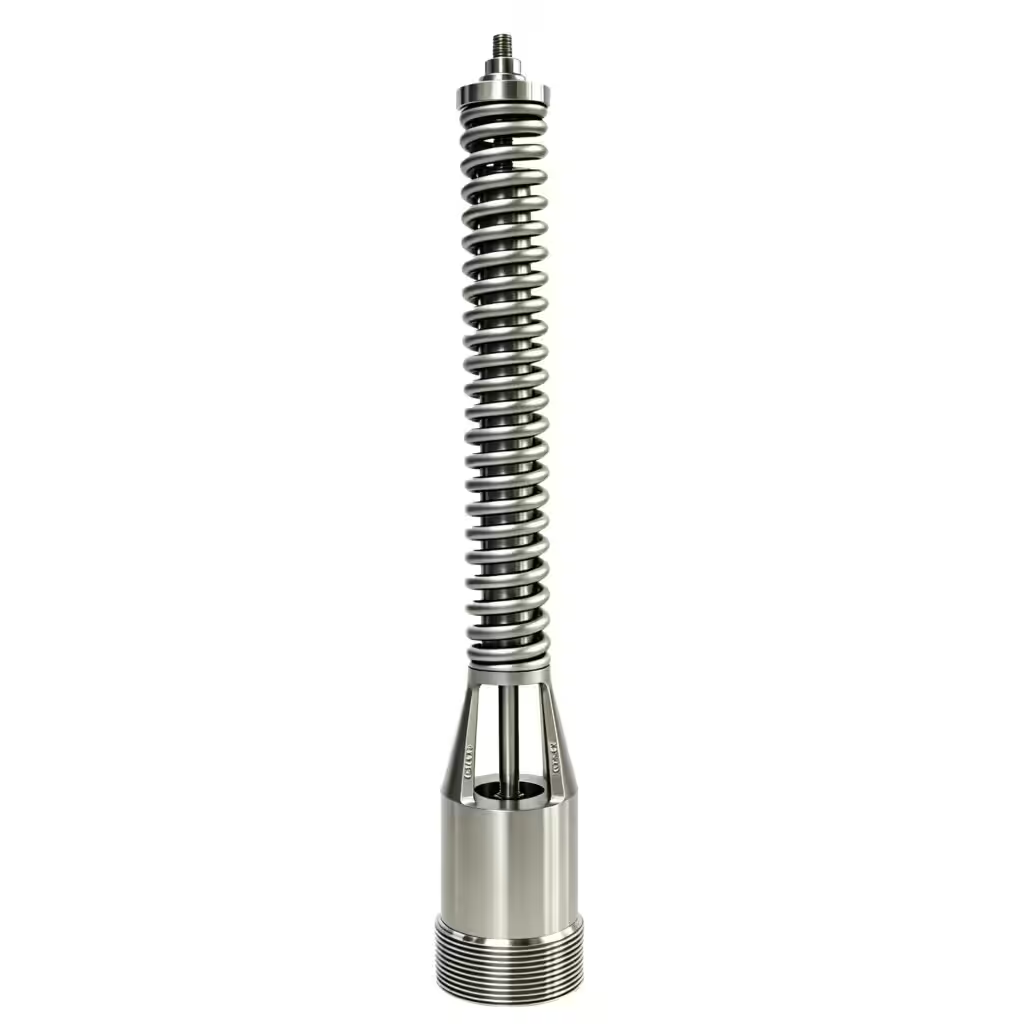
What Is a Fully Internal Relief Valve?
A fully internal relief valve is a pressure relief valve designed so that its main functional components are protected inside or below the tank coupling area. In transport tank applications, this design helps reduce the risk of damage caused by impact, handling, vibration, road conditions, or accidental external contact.
In practical terms, “fully internal” does not simply mean that the entire valve disappears inside the vessel. The key point is that the major working parts are located below the external tank connection level, while the visible exposed portion is kept as low as possible.
This design is especially valuable for mobile LPG and anhydrous ammonia transport service, where the valve is installed on top-mounted tank couplings and may be exposed to weather, vibration, road conditions, inspection activities, and external impact risks that are more demanding than stationary pressure vessel installations.
For engineers and tank builders, the main benefits include:
- Reduced external profile above the tank coupling
- Better protection against mechanical damage
- Lower risk of tampering or accidental adjustment
- Improved suitability for mobile tank service
- Compact installation for bobtail and transport tank layouts
- Easier integration into existing 2″ and 3″ relief valve connections
| THINKTANK Model | Nominal Connection | Typical Application |
|---|---|---|
| TRV-100 | 2″ M.NPT | LPG / NH3 transport tanks, bobtail delivery vehicles, nurse tanks, and replacement review projects |
| TRV-200 | 3″ M.NPT | Higher-capacity LPG / NH3 transport tanks, cargo tanks, and mobile pressure vessel applications |
| Component | Material |
|---|---|
| Body | Stainless Steel 316 |
| Spring | Stainless Steel 316 |
| Stem | Stainless Steel 316 |
| Stem Bushing | 17-4PH Stainless Steel |
| Seat Disc | Stainless Steel 316 + PTFE/Viton |
For safety-critical applications, this structure must still be supported by correct set pressure, verified flow capacity, suitable materials, reliable sealing design, and proper testing.
Why Fully Internal Relief Valves Are Used for LPG and NH3 Tanks
LPG and anhydrous ammonia are both pressure-liquefied gases. During transportation, loading, unloading, parking, or emergency heat exposure, pressure may increase due to external heat, fire exposure, overfilling, thermal expansion, or abnormal operating conditions.
A pressure relief valve must open at the required set pressure and discharge enough vapor to prevent excessive pressure accumulation in the vessel. For mobile tanks, the valve must also withstand vibration, frequent movement, outdoor exposure, and limited maintenance access.
Fully internal relief valves are often selected because they offer a practical combination of compact design and protected construction. This is particularly important for:
- LPG bobtail delivery vehicles
- Anhydrous ammonia nurse tanks
- ASME transport tanks
- LPG transport tanks
- Propane and butane service tanks
- NH3 distribution and agricultural service tanks
- Tank repair and retrofit projects
- Relief valve replacement and cross-reference projects
In these applications, a small difference in height, thread engagement, spring behavior, seat material, or flow capacity may affect whether the valve is suitable for the tank.
Therefore, valve selection should always be treated as an engineering review, not only a purchasing comparison.
Pop-Action Design: Why Opening Behavior Matters
For LPG and NH3 tank protection, the opening behavior of the relief valve is very important. A pop-action relief valve is designed to remain closed under normal operating conditions and open rapidly when the pressure reaches the required relieving point.
In a typical pop-action design, the valve may begin to lift as pressure approaches the set point. Once the required opening condition is reached, the valve opens quickly to provide high discharge capacity. This helps reduce pressure accumulation more effectively than a slow-opening design.
For transport tank applications, this is important because overpressure events may develop quickly, especially under heat exposure or emergency conditions. A relief valve must not only open; it must open with enough capacity and stability to protect the vessel.
When evaluating a fully internal relief valve, engineers should confirm:
- Set pressure accuracy
- Opening characteristics
- Reseating performance
- Rated flow capacity
- Seat leakage performance
- Spring stability
- Compatibility with vapor service
- Test method and inspection record
A valve that looks similar from the outside may perform very differently if the internal spring, disc, seat, guide, and flow path are not properly designed.
Key Selection Parameters for LPG / NH3 Fully Internal Relief Valves
When selecting a fully internal relief valve for LPG or anhydrous ammonia service, the following parameters should be confirmed before ordering or approving a replacement.
| Parameter | Why It Matters |
|---|---|
| Set Pressure | Must match the tank design pressure and applicable code requirements. Common project requirements may include 250 PSIG or 265 PSIG, but this must always be confirmed against the vessel design. |
| Connection Size | Fully internal relief valves are commonly used with 2″ or 3″ male NPT tank connections. Thread type and engagement length must be checked carefully. |
| Flow Capacity | The valve must provide sufficient discharge capacity for the vessel and emergency scenario. Flow capacity should be reviewed using the correct reference conditions and test basis. |
| Medium | LPG, propane, butane, propylene, and NH3 may require different sealing material and compatibility checks. |
| Body Material | Stainless steel construction is preferred for corrosion resistance, outdoor exposure, and long-term durability. |
| Seat Material | The soft seat or elastomer must be compatible with the service medium and temperature range. |
| Spring Material | Spring performance affects set pressure stability, opening behavior, and service life. |
| Internal Guide Design | Stable guiding helps ensure repeatable opening and closing under dynamic pressure conditions. |
| Height Above Coupling | Low-profile construction reduces the risk of impact damage on mobile tanks. |
| Installation Tooling | Fully internal valves may require specific tools for installation and removal. |
| Documentation | Material certificate, pressure test report, set pressure report, and dimensional drawing may be required for project approval. |
For replacement or retrofit projects, dimensions should not be assumed. Even when the nominal size and set pressure appear to match, engineers should verify thread details, overall height, internal clearance, flow capacity, and installation compatibility.
Stainless Steel Construction for Demanding Tank Service
LPG and NH3 transport tanks operate in outdoor environments and are often exposed to moisture, dust, road LPG and anhydrous ammonia transport tanks are often used in outdoor and mobile environments. Relief valves installed on these tanks may be exposed to vibration, road conditions, weather, moisture, inspection activities, and long-term pressure cycling.
For this reason, THINKTANK TRV Series fully internal relief valves use stainless steel construction for the main pressure and moving components.
The body, spring, and stem are manufactured from stainless steel. The stem bushing is made from 17-4PH stainless steel, providing strength, wear resistance, and stable guiding performance. For sealing, the standard seat disc is designed with Stainless Steel 316 + PTFE, while Viton can be reviewed for specific service conditions.
This construction is designed to support demanding LPG and NH3 transport tank applications where corrosion resistance, repeatable opening performance, and reliable sealing are important.
However, material selection should not be assumed only by product name. For anhydrous ammonia, propylene, or mixed LPG service, the seat material should always be checked against the actual medium composition and temperature range.
Flow Capacity Is More Important Than Valve Appearance
For relief valves, appearance is never enough. A fully internal relief valve must be evaluated by its actual relieving capacity.
Two valves may both have a 2″ NPT or 3″ NPT connection, but their flow capacity can be very different due to internal flow path, disc design, spring force, lift, orifice area, and guide structure.
When selecting a relief valve for LPG or NH3 tank service, engineers should ask:
- What is the rated flow capacity?
- What is the test medium?
- Is the flow capacity expressed in SCFM of air or another unit?
- At what pressure condition was the flow capacity measured?
- Is the capacity suitable for the tank size and relief requirement?
- Can the manufacturer provide a flow test report or calculation support?
- Is the valve suitable for vapor relief service?
For tank builders and maintenance companies, flow capacity is often the deciding factor in whether a valve can be approved for a specific vessel.
THINKTANK can support customers with pressure setting verification, relief capacity review, dimensional drawing, and documentation preparation for LPG and NH3 transport tank projects.
2″ and 3″ Fully Internal Relief Valve Applications
In LPG and NH3 transport tank markets, 2″ and 3″ threaded fully internal relief valves are commonly used depending on tank size, required flow capacity, and vessel design.
A 2″ fully internal relief valve is often used where the required capacity is moderate and the tank connection is designed around a compact relief valve arrangement. A 3″ fully internal relief valve is typically selected where higher discharge capacity is required.
Typical applications include:
- 2″ M.NPT LPG relief valve applications
- 2″ M.NPT NH3 relief valve applications
- 3″ M.NPT LPG transport tank relief valves
- 3″ M.NPT anhydrous ammonia relief valves
- Bobtail delivery vehicle relief valves
- Mobile propane tank relief valve systems
- Tank retrofit and maintenance replacement projects
When customers are reviewing 2″ or 3″ fully internal relief valve options, the engineering team should compare not only connection size, but also flow capacity, set pressure, total height, installation depth, sealing material, and documentation.
Cross-Reference Review for Existing 2″ and 3″ Internal Relief Valve Installations
Many customers are not selecting valves for a new tank. They are looking for a technically suitable valve for an existing LPG or NH3 transport tank installation.
In the market, common 2″ and 3″ fully internal relief valves are widely used on LPG bobtail vehicles, anhydrous ammonia tanks, and ASME transport tanks. When customers review common model families such as A8434-type or A8436-type internal relief valve installations, it is important not to select a new valve only by nominal size or set pressure.
For these projects, THINKTANK can support a cross-reference engineering review based on:
| Review Item | Required Information |
|---|---|
| Existing valve model | Nameplate photo or model number |
| Tank connection | 2″ M.NPT or 3″ M.NPT |
| Set pressure | For example, 250 PSIG, 265 PSIG, or project-specific requirement |
| Medium | LPG, propane, butane, and anhydrous ammonia are typical service media. For propylene or other special media, seat material and compatibility should be reviewed according to the actual project conditions. |
| Required flow capacity | SCFM/Air or other specified unit |
| Installation dimensions | Overall height, coupling depth, thread engagement, and clearance |
| Seat material | Synthetic rubber, Viton, or project-specific material |
| Documentation | Drawing, material certificate, set pressure test report, inspection record |
THINKTANK TRV-100 and TRV-200 can be reviewed for projects requiring 2″ and 3″ stainless steel fully internal relief valve solutions. Final approval should always be based on dimensional compatibility, relief capacity, pressure setting, material compatibility, and applicable local requirements.
Engineering Checklist Before Ordering
Before ordering a fully internal relief valve for LPG or NH3 service, we recommend confirming the following information:
| Required Information | Example |
|---|---|
| Medium | LPG, propane, butane, NH3, propylene |
| Tank Type | Bobtail delivery vehicle, ASME cargo tank, NH3 nurse tank, LPG / NH3 transport tank |
| Connection Size | 2″ M.NPT or 3″ M.NPT |
| Set Pressure | 250 PSIG, 265 PSIG, or project-specific requirement |
| Required Capacity | SCFM/Air or other specified unit |
| Body Material | Stainless steel or project-specific material |
| Seat Material | To be confirmed based on medium compatibility |
| Operating Temperature | Minimum and maximum service temperature |
| Installation Space | Height above coupling and internal clearance |
| Required Documents | Drawing, test report, material certificate, inspection record |
| Replacement Model | Existing valve model for dimensional review |
This information allows the manufacturer to recommend a technically suitable valve instead of only matching a visible size.
THINKTANK Fully Internal Relief Valve Solutions
THINKTANK provides stainless steel fully internal relief valve solutions for LPG and NH3 transport tank applications. Our focus is not only supplying a valve, but helping customers complete the engineering confirmation process.
Our support can include:
- Model cross-reference review
- Dimensional matching review
- Set pressure confirmation
- Material compatibility check
- Relief capacity review
- 2D drawing and technical data sheet
- Material certificate support
- Pressure test and set pressure test record
- Inspection documentation for project approval
For distributors, tank maintenance companies, gas equipment suppliers, and tank builders, this support can help reduce communication time and improve confidence during replacement or new project selection.
For engineering companies and OEM customers, THINKTANK can also support customized review based on tank design, local approval requirements, and project documentation needs.
Why Engineers Should Not Select Relief Valves Only by Set Pressure
One of the most common mistakes in relief valve replacement is selecting a valve only by set pressure.
For example, two valves may both be marked 250 PSIG, but that does not mean they have the same flow capacity, connection depth, material compatibility, or installation profile.
A correct selection should consider at least four engineering layers:
First, pressure protection. The valve must open at the correct set pressure and relieve pressure safely.
Second, capacity protection. The valve must discharge enough vapor to protect the vessel during the required scenario.
Third, mechanical compatibility. The valve must fit the existing tank connection and installation space.
Fourth, material compatibility. The body, spring, stem, guide, seat, and seals must be suitable for the actual medium.
Only when all four layers are confirmed can the valve be considered technically suitable for the application.
Common Questions About Fully Internal Relief Valves
Q1: Can one valve be used for both LPG and NH3 service?
Not always. LPG and anhydrous ammonia may require different material and seat compatibility reviews. The connection size and set pressure may look similar, but the sealing material, corrosion resistance, and project approval requirements should be checked separately.
Q2: Is a 2″ relief valve always interchangeable with another 2″ relief valve?
No. The nominal thread size alone does not guarantee interchangeability. Engineers should compare thread type, installation depth, height above coupling, flow capacity, set pressure, and internal clearance.
Q3: Is stainless steel necessary for LPG and NH3 relief valves?
Stainless steel is commonly preferred for corrosion resistance and long-term outdoor service, especially for transport tanks and mobile applications. However, the final material selection should follow the medium, tank specification, and project requirement.
Q4: What documents are usually required?
Typical documents may include product data sheet, dimensional drawing, material certificate, set pressure test report, pressure test report, inspection record, and packing information. Some projects may require additional certification or third-party approval.
Q5: Can THINKTANK support replacement review for existing valve models?
Yes. THINKTANK can review existing valve model information, dimensions, set pressure, connection size, medium, and required capacity to help customers evaluate a suitable fully internal relief valve solution. Final approval should always be based on technical confirmation and project requirements.
Conclusion
Fully internal relief valves play an important role in LPG and NH3 transport tank safety. For bobtail delivery vehicles, ASME transport tanks, nurse tanks, and mobile pressure vessels, the valve must provide reliable pressure relief while maintaining compact installation and protection against external damage.
A suitable valve should not be selected only by thread size or set pressure. Engineers should review set pressure, relief capacity, pop-action performance, stainless steel construction, seat material compatibility, installation dimensions, and documentation requirements.
THINKTANK provides stainless steel fully internal relief valve solutions for LPG and anhydrous ammonia tank applications. With engineering support for dimensional review, set pressure confirmation, material compatibility, and technical documentation, THINKTANK helps customers select relief valves with greater confidence for demanding tank service.
For LPG, NH3, bobtail, transport tank, or replacement applications, contact THINKTANK with your existing valve model, tank information, set pressure, required capacity, and medium. Our engineering team will help review the most suitable fully internal relief valve solution for your project.