Why many valve problems originate on site—not in design
When control valves fail in service, the investigation often starts with design, materials, or sizing.
In practice, many of these valves were already compromised before normal operation began.
Installation and commissioning are not neutral steps.
They actively shape how a control valve will behave—for the rest of its service life.
Why Installation and Commissioning Matter More Than Expected
From an engineering perspective, control valves are designed to operate within specific mechanical and dynamic assumptions.
Installation and commissioning are the stages where those assumptions are either preserved—or quietly violated.
Once the valve enters service, these early deviations are often misinterpreted as design flaws or product defects.
Common Installation-Related Failure Sources
Incorrect Flow Direction or Orientation
A valve installed against its intended flow direction may still function—but with altered trim loading, sealing behavior, and wear patterns.
The result is often premature degradation, not immediate failure.
Improper Piping Support and Alignment
Misaligned piping introduces external stress into the valve body and actuator.
This stress can:
- Increase friction
- Affect seat alignment
- Distort actuator response
These effects are subtle, cumulative, and difficult to diagnose later.
Contamination During Installation
Debris left in the pipeline—welding slag, scale, or foreign particles—can damage trim surfaces during first operation.
The valve then enters service already worn, even though no abnormal operation has occurred.
Commissioning: Where Behavior Is Set
Commissioning is not simply turning the system on.
It defines how the valve interacts with the process and control system.
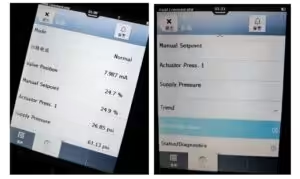
Incorrect Stroke Calibration
If valve travel is not calibrated correctly, control accuracy suffers from the start. Operators may compensate through tuning, masking the real issue.
Aggressive Initial Tuning
Overly aggressive tuning during early operation can push the valve into high-frequency movement before wear patterns stabilize.
This accelerates degradation and creates a false impression of mechanical weakness.
Ignoring Early Warning Signals
Small issues during commissioning—noise, hesitation, minor leakage—are often dismissed as “normal startup behavior.”
In reality, these are often early indicators of long-term problems.
Typical Field Situation: Design Correct, Performance Poor
In a new process unit, control valves met all design and specification requirements.
However, shortly after startup, unstable control and increased maintenance demand appeared. Initial analysis focused on valve sizing and trim selection.
A site review later revealed piping misalignment and debris ingress during installation. The valves were never operating under the conditions assumed during design.
Engineering takeaway:
Many “design problems” are actually installation and commissioning problems revealed later.
Why These Failures Are So Hard to Trace
Installation and commissioning issues are difficult to diagnose because:
- They do not always cause immediate failure
- They create symptoms similar to design or material issues
- Documentation is often incomplete or informal
- Responsibility is distributed across multiple parties
By the time the problem becomes visible, the original cause is already hidden.
Engineering Perspective from THINKTANK
From an engineering standpoint, THINKTANK treats installation and commissioning as extensions of valve design, not external activities:
- Installation requirements are defined as engineering constraints
- Commissioning behavior is considered part of valve lifecycle performance
- Early operating feedback is used to validate design assumptions
- Field practices are integrated into long-term reliability planning
This approach helps prevent early-life failures that are often misattributed to product quality.
How Engineers Can Reduce Installation-Driven Risk
A practical engineering approach includes:
- Clear installation orientation and support requirements
- Defined cleanliness standards before startup
- Controlled commissioning procedures
- Early monitoring of valve behavior during initial operation
These steps do not eliminate risk—but they significantly reduce the likelihood that a valve begins its life already compromised.
Lifecycle Engineering Insight
Control valve performance is not defined at the factory gate.
It is finalized on site.
When installation and commissioning are treated as engineering steps,
valve behavior becomes predictable.
When they are treated as logistics,
failures become inevitable.
Understanding this distinction completes the lifecycle view of control valve reliability.