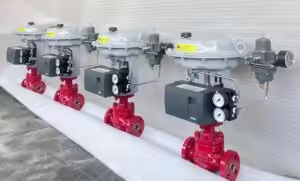
Why valve selection in hazardous areas is about consequences, not components
Hazardous environments rarely reveal their risks during normal operation.
They expose them when something goes wrong.
In many hazardous-area projects, engineers do not ask which valve is suitable—they ask:
What happens to the system if this valve fails?
This shift in thinking marks the boundary between component-level selection and system-level risk engineering. In hazardous environments, control valves are chosen not for what they are, but for what they prevent—or allow—to happen next.
What Makes an Environment “Hazardous” from a Valve Perspective
From an engineering standpoint, an environment becomes hazardous when valve failure can lead to:
- Release of flammable, toxic, or high-energy media
- Ignition, explosion, or fire escalation
- Loss of containment with limited mitigation options
- Rapid propagation of failure to adjacent systems
In these conditions, a control valve is no longer just a regulating device.
It becomes an active element in the plant’s risk control strategy.
Why Component-Level Thinking Breaks Down in Hazardous Service
Most hazardous-area valve problems do not originate from ignorance or poor intent.
They result from treating valves as isolated components rather than system elements.
It is common to see projects focus on:
- Correct material selection
- Required certifications
- Pressure and temperature ratings
All of these may be correct—and still insufficient.
Compliance defines permission to operate.
It does not define system survivability.
A valve can meet every specification and still introduce unacceptable risk if its failure behavior conflicts with the system’s protection logic.
Failure Consequences That Actually Drive Engineering Decisions
In hazardous environments, engineers evaluate valves based on consequence, not probability alone.
Loss of Containment
Minor stem or seat leakage may be manageable in benign service. In hazardous systems, it becomes a primary risk driver.
Uncontrolled Flow
A valve stuck open or closed can initiate overpressure, combustion instability, or process runaway—often faster than operators can respond.
Delayed or Unpredictable Response
Valves tied to shutdown or interlock systems must behave consistently under abnormal conditions. A delayed response can be as dangerous as no response at all.
How Engineering Priorities Change in Hazardous Areas
Once risk dominates the discussion, selection criteria shift fundamentally.
Fail-Safe Philosophy
Fail-open or fail-close is not a preference. It is a system decision derived from hazard analysis.
Sealing and Fugitive Emissions
Packing and seat design become safety-relevant features, not maintenance details.
Actuation and Control Integration
Valve behavior during power loss, signal failure, or emergency shutdown becomes as important as normal operation.
Maintainability as Risk Exposure
Every maintenance intervention in a hazardous zone increases exposure. Reducing maintenance frequency is itself a form of risk reduction.
Typical Field Situation: Certified, Acceptable—But Not Safe Enough
In a hazardous process unit, a control valve met all required material and certification standards, including ATEX compliance.
From a specification-based view, the valve was acceptable.
From a system-risk perspective, it was not.
Frequent minor leakages during thermal cycling increased personnel exposure and required repeated maintenance in a hazardous area. By redesigning the sealing system and extending maintenance intervals, overall system risk was significantly reduced—without changing certification scope.
Engineering takeaway:
In hazardous environments, reducing exposure and intervention can be as critical as meeting formal requirements.
Engineering Perspective from THINKTANK
From an engineering standpoint, THINKTANK approaches hazardous-environment valve selection as a risk-management exercise, not a component checklist:
- Failure modes are evaluated in terms of system consequences
- Valve behavior under abnormal conditions is prioritized
- Sealing, actuation, and control integration are treated as safety-relevant design elements
- Maintainability is considered part of long-term risk control
This approach aligns valve design decisions with hazard analysis outcomes rather than minimum compliance.
How Engineers Should Frame Valve Decisions in Hazardous Areas
A practical system-level approach starts with different questions:
- What is the worst credible consequence of valve failure?
- How does the valve behave during loss of power or signal?
- Does the valve reduce system risk over its life cycle—or increase it?
Only after these questions are answered do material grades and certifications become meaningful.
System-Level Engineering Insight
In hazardous environments, control valves are not selected to meet specifications.
They are selected to limit consequences.
When failure cannot be eliminated,
the only acceptable outcome is controlled, predictable system behavior.
That principle—not component performance alone—defines sound engineering in hazardous service.
Related engineering checks
For the next design review, document the fail-position decision and its process consequences, verify the solenoid-valve and interlock logic, and confirm the actual operating conditions used for valve selection. These checks connect the hazardous-area specification to the complete shutdown and operating scenario.