— From the Perspective of THINKTANK Control Valve Engineers
Why handwheel mechanisms still matter in modern chemical plants
In chemical plants, many control valves operate continuously for long periods and cannot be isolated for maintenance.
When a remote control failure occurs, the handwheel mechanism often becomes the only way to maintain basic process control.
In addition, many control valves use pneumatic or electric positioners that require the valve to be mechanically fixed at 50% stroke during installation and calibration.
In these cases, the handwheel is not optional — it is an essential auxiliary device.
From our engineering perspective, a control valve without a reliable handwheel is not fully maintainable.
What should be checked first after valve maintenance
After valve maintenance is completed, the first mechanical action should not be putting the valve into automatic mode.
It should be manual operation using the handwheel.
At this stage, two basic checks must be completed:
- Whether the valve travel through the handwheel matches the valve travel scale
- Whether the handwheel mechanism operates smoothly and completely over the full stroke
This simple step verifies that:
- the actuator is correctly installed,
- mechanical transmission is intact,
- and the valve can be controlled manually if required.

Why handwheel problems are often overlooked
In modern control systems, most control valves are equipped with smart positioners.
Once automatic control appears normal, attention naturally shifts to:
- signal quality,
- tuning parameters,
- and control performance.
The handwheel mechanism is often ignored because it is not part of the normal automatic control loop.
As a result, handwheel integrity is frequently not checked after maintenance, even though it was directly involved during positioner installation and calibration.
A typical failure scenario we help customers diagnose
This type of problem usually appears only when the handwheel is urgently needed.
What happens on site:
- A control issue requires manual intervention
- Operators attempt to use the handwheel
- The handwheel cannot move the valve
- Process control cannot be maintained
- Normal operation is disrupted
What we often find:
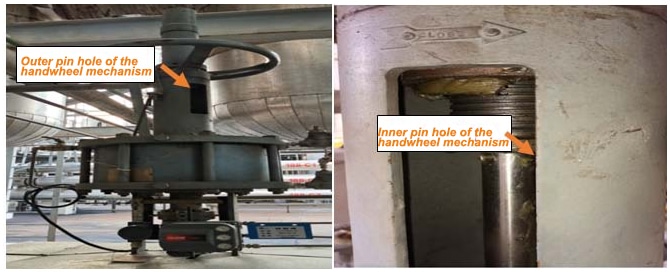
- Actuator installation pins are not correctly aligned
- Inner and outer pin holes do not correspond
- Mechanical engagement between handwheel and actuator is incomplete
In some cases, the handwheel rotates freely without driving the valve at all.
Why this failure is especially disruptive
Handwheel failures are particularly damaging because:
- they appear only under abnormal or emergency conditions,
- they eliminate the last manual control option,
- and they undermine operator confidence in the valve system.
At this point, troubleshooting is no longer a control issue — it becomes a mechanical problem that may require immediate shutdown or disassembly.
How THINKTANK engineers verify handwheel functionality
When we review control valves after maintenance, handwheel verification is mandatory.
Our checks include:
- manually driving the valve through its stroke using the handwheel,
- confirming alignment between handwheel travel and valve position indicator,
- inspecting actuator pin engagement and installation accuracy,
- verifying that the handwheel can hold the valve at a fixed position when required.
These checks take little time but eliminate a class of failures that are extremely difficult to handle during operation.
Engineering corrections we typically recommend
Based on repeated field experience, we recommend the following:
- Handwheel operation must be tested after every valve maintenance activity
- Actuator installation pins and holes must be visually confirmed for correct alignment
- Handwheel functionality should be included as a mandatory item in valve maintenance checklists
- Manual operation capability should never be assumed based on automatic performance
A valve that works well in automatic mode but cannot be operated manually is not fully serviceable.
Our engineering conclusion
Handwheel mechanisms rarely attract attention — until they fail.
From our perspective:
A control valve that cannot be operated manually when needed
is not revealing a design problem,
but a maintenance verification gap.
In control valve engineering, manual operability is not a backup feature.
It is part of the valve’s fundamental reliability.