Product Overview
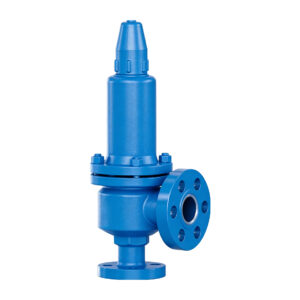
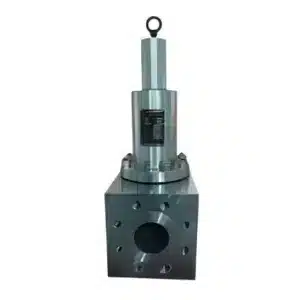
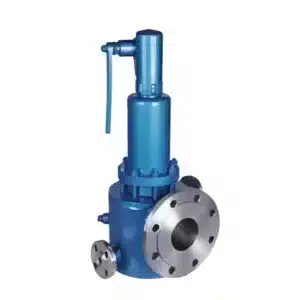
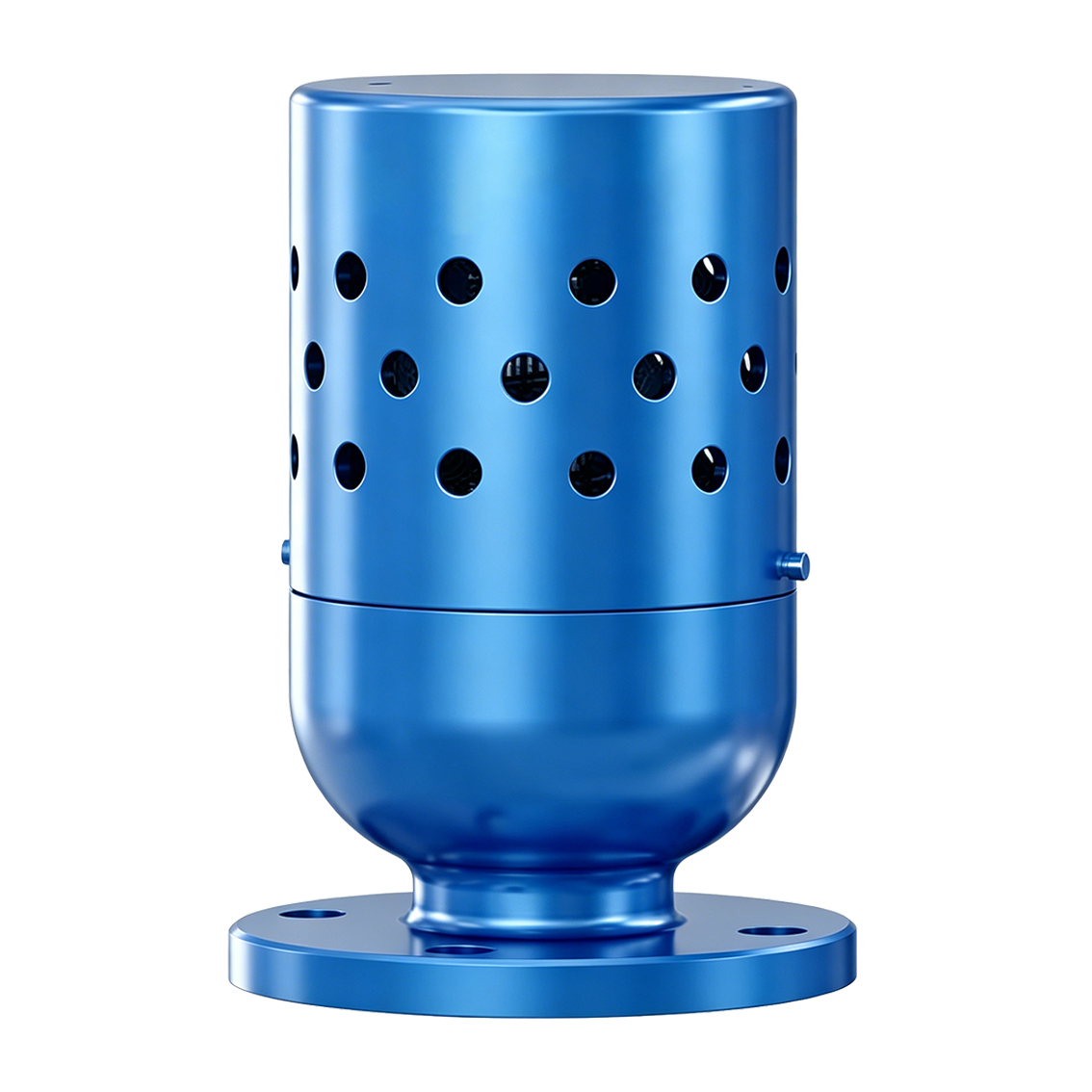
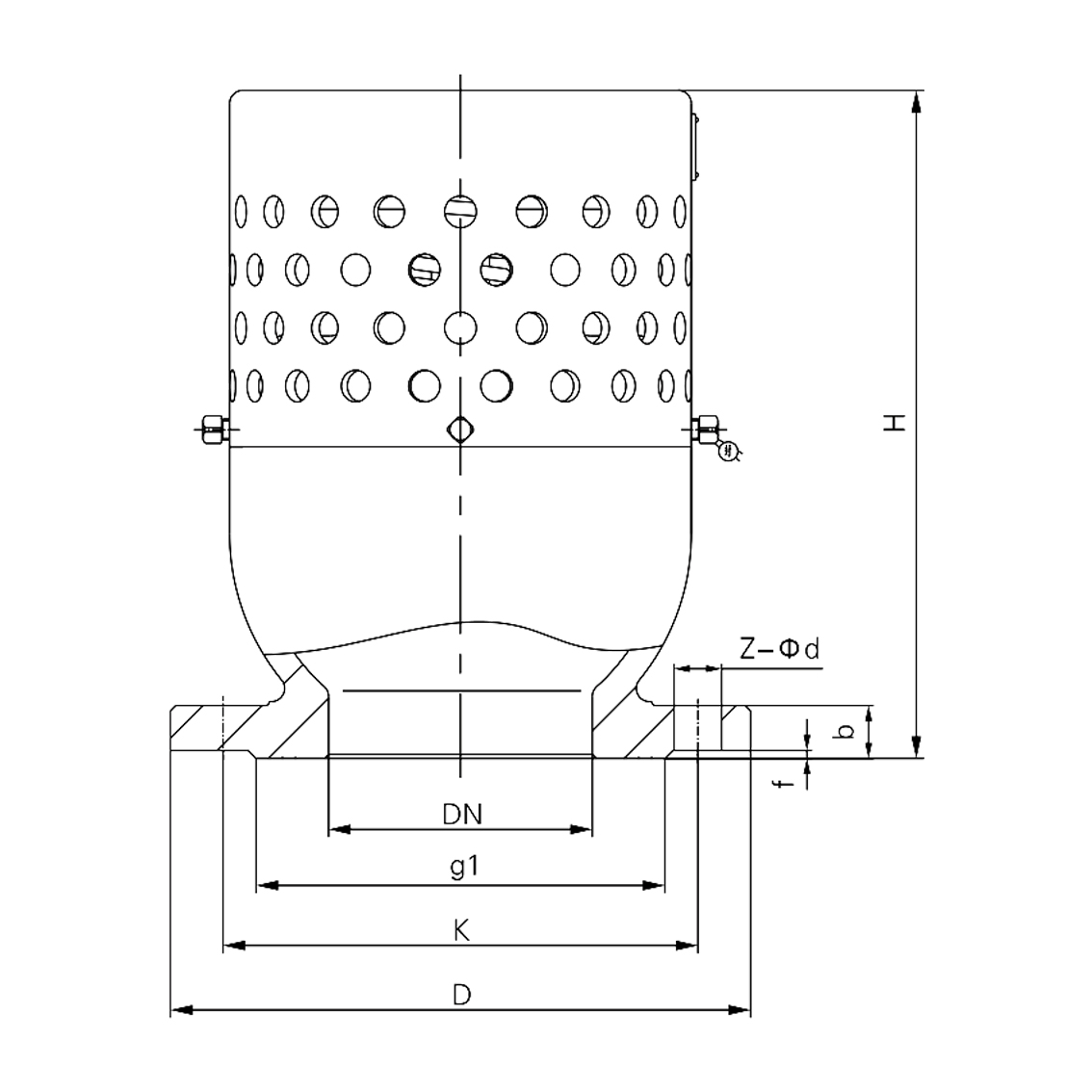
The THINKTANK TT-VA72W is a vacuum relief valve designed to protect equipment and piping systems against excessive vacuum or negative pressure.
When the vacuum level inside the protected vessel or system exceeds the allowable preset limit, the valve opens automatically and admits air into the system.
As the internal vacuum decreases to the preset closing condition, the valve closes automatically.
This operating principle helps prevent structural damage that may result when vessels, columns, tanks or piping are subjected to vacuum levels beyond their allowable design condition.
Vacuum Service
For equipment operating under vacuum conditions, the TT-VA72W provides automatic protection against excessive negative pressure.
During normal operation, the valve remains closed.
If the internal pressure continues to decrease and the vacuum reaches the specified opening setting, the pressure differential causes the valve to open.
Air is then admitted into the protected system, reducing the vacuum.
When the vacuum decreases to the required closing condition, the valve recloses automatically.
The valve therefore provides an automatic means of limiting excessive vacuum within the protected equipment.
Protection for Normally Non-Vacuum Equipment
The TT-VA72W can also be applied to equipment that does not normally operate under vacuum but may experience temporary negative pressure during certain operating conditions.
Typical equipment includes:
- Absorption towers
- Distillation columns
- Storage tanks
- Process vessels
- Process piping
- Equipment subjected to steam cleaning or steam purging
A common vacuum-generation scenario occurs after steam purging or steam cleaning.
If steam remains inside a closed vessel or piping system and begins to condense while adequate venting is unavailable, the vapor volume decreases rapidly and a vacuum can develop inside the equipment.
Under this condition, the TT-VA72W automatically admits air when the preset vacuum limit is reached, helping prevent vacuum-induced damage.
Quick Specifications
| Parameter | Specification |
|---|---|
| Model | TT-VA72W |
| Product Type | Vacuum Relief Valve / Vacuum Safety Valve |
| Protection Type | Negative-Pressure / Vacuum Protection |
| Connection | Flanged |
| Listed Size Range | DN15–DN250 |
| Opening Function | Admits air when excessive vacuum occurs |
| Closing Function | Automatically recloses after vacuum is reduced to the preset condition |
| Typical Equipment | Towers, columns, tanks, vessels and piping |
| Typical Vacuum Cause | Steam condensation after purging or cleaning |
| Manufacturer | THINKTANK |
How It Works
The TT-VA72W responds to the pressure differential between the protected equipment and the surrounding atmosphere.
Under acceptable internal pressure conditions, the valve remains closed.
As the internal pressure decreases, the differential pressure across the valve increases.
When the preset vacuum opening condition is reached, the valve opens and allows air to enter the protected equipment.
The incoming air increases the internal pressure and reduces the vacuum level.
When the pressure differential returns to the specified closing condition, the valve closes automatically.
Unlike a conventional positive-pressure safety valve that discharges fluid from a system, the TT-VA72W protects against excessive negative pressure by admitting air into the system.
Why Vacuum Protection Is Required
Many pressure vessels and storage systems are designed to withstand significantly less external pressure differential than internal positive pressure.
Excessive vacuum can therefore create a risk of:
- Vessel shell deformation
- Tank buckling
- Column deformation
- Mechanical damage to process equipment
- Piping collapse
- Damage during draining or pump-out
- Vacuum formation after steam condensation
A properly selected vacuum relief valve limits the maximum vacuum level before the equipment reaches its allowable negative-pressure condition.
Typical Vacuum-Generation Scenarios
The TT-VA72W can be considered where vacuum may result from:
- Steam condensation after steam purging
- Steam condensation after vessel cleaning
- Rapid cooling of a closed system
- Liquid withdrawal from a vessel
- Pump-out of stored liquid
- Process vapor condensation
- Unexpected restriction or failure of a normal vent path
- Vacuum-system operating disturbances
The governing vacuum scenario should be identified before determining the required valve size.
Vacuum Relief Valve Selection
Correct sizing of a vacuum relief valve requires more than the nominal vessel or piping size.
The following application data should be established:
- Protected equipment type
- Vessel or system volume
- Normal operating pressure
- Design pressure
- Allowable vacuum / external design pressure
- Required vacuum opening setting
- Required closing condition
- Maximum required air inflow capacity
- Maximum liquid withdrawal or pump-out rate
- Steam purging conditions, if applicable
- Maximum steam condensation rate, if applicable
- Operating temperature
- Process medium
- Whether admitting atmospheric air is acceptable
- Required valve materials
- Inlet flange size and standard
- Installation arrangement
The required air-admission capacity should be based on the worst credible vacuum-generation scenario, rather than selecting the valve only according to vessel connection size.
Steam Purging and Condensation Service
Steam cleaning and steam purging can create a particularly severe vacuum condition.
While steam is present, the vessel may initially remain near atmospheric or positive pressure.
As the steam subsequently condenses, a large volume of vapor can convert into a much smaller volume of liquid condensate.
If sufficient replacement air cannot enter the equipment, internal pressure may decrease rapidly.
For this type of application, vacuum valve selection should consider:
- Steam quantity
- Condensation rate
- Vessel volume
- Cooling conditions
- Existing vent capacity
- Allowable equipment vacuum
- Required air inflow rate
The vacuum relief valve should provide sufficient admission capacity to prevent the equipment vacuum from exceeding its allowable limit.
Atmospheric Air Admission
The standard operating description of the TT-VA72W is based on admitting air into the protected equipment.
For processes where atmospheric air must not enter because of:
- Oxidation risk
- Product contamination
- Flammable process conditions
- Inerted systems
- High-purity process requirements
the required vacuum-relief medium and system arrangement should be evaluated separately.
In such applications, an engineered gas-inlet or inert-gas protection arrangement may be more appropriate than unrestricted atmospheric air admission.
Dimensions
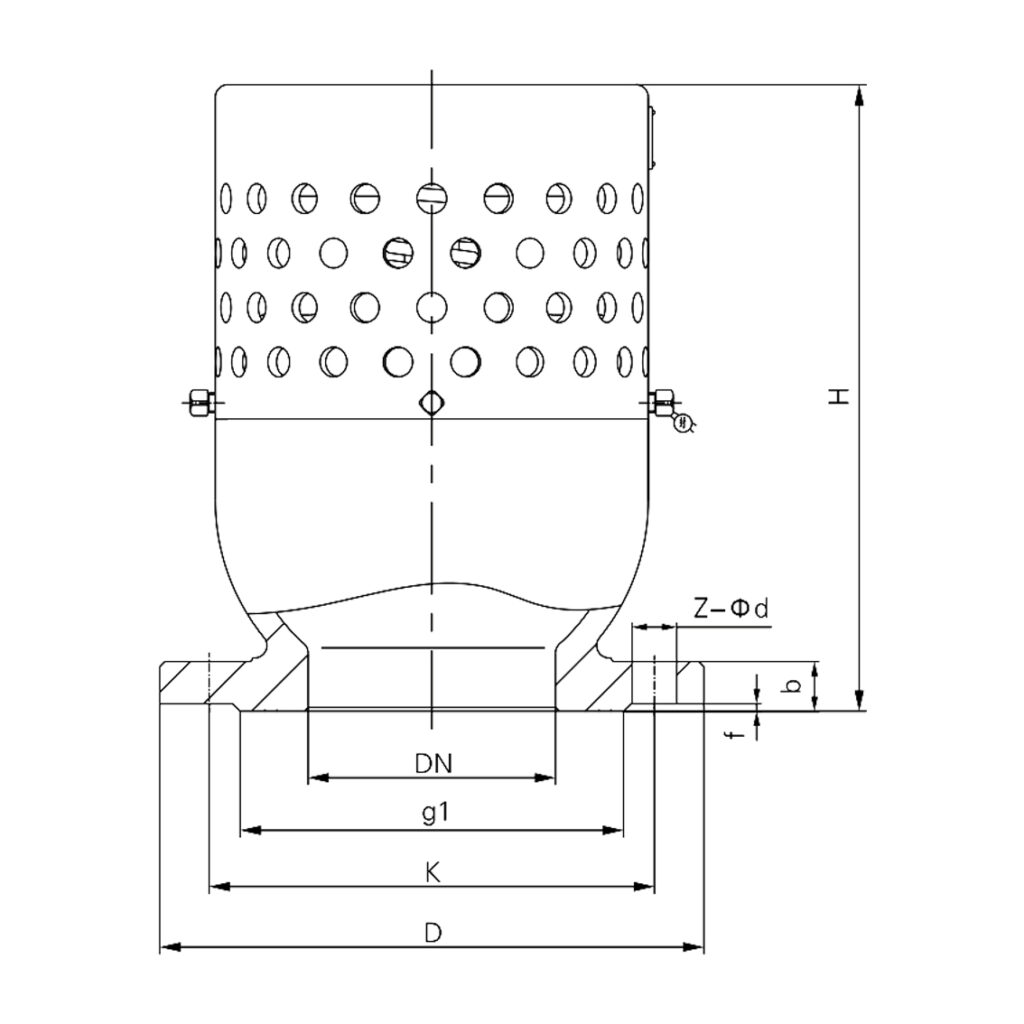
| DN | D (mm) | K (mm) | G1 (mm) | Z1–Ød | B (mm) | F (mm) | H Approx. (mm) |
| 15 | 95 | 65 | 45 | 4–14 | 14 | 2 | 230 |
| 20 | 105 | 75 | 55 | 4–14 | 16 | 2 | 230 |
| 25 | 115 | 85 | 65 | 4–14 | 16 | 2 | 230 |
| 32 | 140 | 100 | 78 | 4–18 | 16 | 2 | 230 |
| 40 | 150 | 110 | 85 | 4–18 | 16 | 3 | 230 |
| 50 | 160 | 125 | 100 | 4–18 | 18 | 3 | 240 |
| 80 | 200 | 160 | 135 | 4–18 | 20 | 3 | 255 |
| 100 | 220 | 180 | 155 | 8–18 | 20 | 3 | 265 |
| 125 | 250 | 210 | 185 | 8–18 | 22 | 3 | 325 |
| 150 | 285 | 240 | 210 | 8–23 | 24 | 3 | 365 |
| 200 | 340 | 295 | 265 | 8–23 | 24 | 3 | 465 |
| 250 | 395 | 350 | 320 | 12–23 | 25 | 3 | 550 |
Dimensions are for preliminary engineering and layout reference. Final approved dimensional drawings should be confirmed before piping fabrication or installation.
Engineering Support
THINKTANK supports EPC contractors, tank and vessel manufacturers, process system integrators and industrial users with:
- Vacuum relief valve selection
- Vacuum opening-setting review
- Required air-inflow capacity evaluation
- Steam-condensation scenario review
- Liquid pump-out scenario evaluation
- Material selection
- Dimensional drawings
- 3D models for system integration
- Existing vacuum valve replacement evaluation
- Project-specific technical documentation
For vacuum-protection applications, engineering review should focus on both the allowable equipment vacuum and the maximum rate at which vacuum can develop.